Monday, December 10, 2012

Zanqueros


Transcomunalidad Intervenciones Y Colaboraciones Con Comunidades De Zanqueros

El 7 de diciembre, el museo textil tuvo una inauguración de la Transcomunalidad Intervenciones Y Colaboraciones Con Comunidades de Zanqueros. Como una parte de la inauguración hubo una actuación de zanqueros de Oaxaca, Mx y Brooklyn, NY. En el museo se pueden ver los trajes de muy buena calidad y una colección de muñecas vestidas como zanqueros. La exposición continúa hasta el 12 de abril.

Esta descripción es de folleto de la exposición del Museo Textil:

La presente exposición es una muestra del trabajo realizado por Laura Anderson Barata, artista multidisciplinar, en conjunto con zanqueros tradicionales de las Antillas y México.  En colaboración con Miembros de la comunidad y artesanos tradicionales, Laura fusiona dinámicas del arte contemporáneo y participativas. Cada una de las piezas que se presentan en esta muestra han formado parte de una celebración, de una ceremonia, o bien, de intervenciones espontáneas, como en el Carnaval de Puerto Espana, El Desfile de las Antillas de Brooklyn, el Museo de Arte Moderno de Nueva York, las calles de Wall Street en Nueva York, y los Festejos de San Pedro y San Pablo en Zaachila, Oaxaca.  En las obras resultantes confluyen las nociones de arte comunitario, arte público, performance, escultura y tradición.

Transcomunalidad presenta el inicio de este proyecto en Trinidad y Tobago y la integracion que ha hecho Laura con un grupo de zanqueros de las Indias occidentales y África Occidentale que actualmente vive en Brooklyn: The Brooklyn Jumbies. Más recientemente se han incorporado Los zancudos de Zaachila, en Oaxaca.  La unión de estas tradiciones vivas en colaboración ha sido un ejercicio de acompañamiento: su propuesta ha creado puentes entre continentes, culturas y comunidades, donde los trajes resultantes demuestran la fusión del arte contemporáneo con aspectos tangibles e intangibles del patrimonio cultural.

Hay muchas más fotos si usted va a mi álbum web de Picasa haciendo clic aquí.


On the 7th of December the textile museum had an inauguration of the Transcomunalidad Intervenciones Y Colaboraciones Con Comunidades De Zanqueros.  As a part of the inauguration there was a performance by stilt walkers from Oaxaca, Mx and Brooklyn, NY.  In the museum you can see costumes of very fine quality and a collection of dolls dressed as stilt walkers.  The exhibition continues until the 12th of April.

This exhibition is the work of Laura Anderson Barata, multidisciplinary artist, along with traditional stilt walkers of the Antilles and Mexico. In collaboration with community members and traditional craftsmen, Laura merges the dynamics of contemporary art and participation. Each of the pieces presented in this exhibition have been part of a celebration, a ceremony, or spontaneous intervention, as in the Carnival of the Port of Spain, the West Indian Parade in Brooklyn, the Museum of Modern Art New York, the streets of Wall Street in New York, and San Pedro and San Pablo Celebrations in Zaachila, Oaxaca. The resulting works bring together the notions of community art, public art, performance, sculpture and tradition.

Transcomunalidad presents the beginning of this project in Trinidad and Tobago and the integration that Laura made with a group of West Indian and Western Africa stilt walkers now living in Brooklyn: The Brooklyn Jumbies, and more recently having incorporated Los Zancudos de Zaachila in Oaxaca. That the union of these traditions live in collaboration has been an exercise in accompaniment; the proposal has created bridges between continents, cultures and communities, where the resulting fusion of costumes show contemporary art with tangible and intangible aspects of cultural heritage.

There are many more photos if you go to my Picasa Web Album by clicking here.

Friday, September 14, 2012

Nuevo diseno textil 2011 (en español y en inglés)


Para citar a Alejandro de Ávila B., curador del exposiciones en el Museo Textil de Oaxaca.


Zenaida Pérez Mendoza es una tejedora magistral de Pinotepa de Don Luis, en la costa de Oaxaca.  Zenaida habla tu un savi que podemos traducir como palabra de la lluvia sagrada.  En español designamos a su lengua y a su pueblo como mixtecos, termino derivado del náhuatl mixtecah, gente de los nubes. El año pasado de 2010, Zenaida tejió tres lienzos para un huipil que le encargó Remigio Mestas Revilla, apasionada promotor del arte textil de Oaxaca.  Zenaida tejió esta vez el tipo más fino de huipil, usado antiguamente por una mujer el día que se casaba y guardado por ella con cuidado toda su vida para ser enterrada en él cuando moría. Olga González Pérez, hija de Zenaida, ha seguido los pasos de su madre. Ahora teje lienzos aun más delicados, casi transparentes, donde los diseños, blancos parecen flotar en el aire.  No es probable que Olga vista un huipil para su boda porque, a diferencia de su madre, ella no usa el posahuanque, la falda de enredo de las mujeres mixtecas de la costa. Huipil y posahuanque  son íconos de la identidad indígena, y la juventud de Don Luis ya no quiere ser discriminada por su herencia cultural. Pero de manera paralela y contradictoria, la habilidad de Olga y de Zenaida como tejedoras se ha refinada conforme sus lienzos son reconocidos en el ámbito urbano como arte a secas, sin el calificativo "popular".  Nos parece poéticamente justo que la gente de las nubes siga distinguiendose por obras tan etéreas.


Esta exposición muestra el trabajo de Olga y otras artistas destacadas del telar y la aguja hoy día. Se trata en todos los casos de piezas especiales, hechas por encargo para ser vendidas y admiradas fuera de su comunidad de origen.  Los lienzos tejidos en Don Luis ejemplifican esta tendencia innovadora: Remigio le proporcionó a Olga hilo de algodón egipcio para las diseños brocados. Varias otras piezas aquí expuestas fueron hechas de igual manera con hilaturas industriales de alta calidad, que no se consiguen en el mercado nacional.  Muchas de los tejidos que presentamos combinan esos materiales importados con hilados manuales de seda y algodón teñidos con los colorantes más apreciados de Oaxaca y de México: la grana del nopal, el caracol púrpura y el añil vegetal. Si bien los tintes por sí mismos nos remiten al pasado mesoamericano, las tonalidades puras logradas para esta muestra son sutilmente distintas de las piezas antiguas. Más aun, las combinaciones cromáticas son en muchas casos radicalmente diferentes de los huipiles y enredos que vistieron las abuelas de estas artistas, pero manifiestan un sentido del color tan rico y consumado como los mejores tejidos clásicos de Oaxaca.


Podemos apreciar ese mismo patrón de innovaciones harmoniosas si examinamos el diseño de las piezas expuestas. Olga y sus companeras de generación han retomado las figuras tradicionales, recreandolas con ajustes de escala y densidad para lograr composiciones novedosas. En algunos casos han ideado una iconografía enteramente distinta, que sin romper con los cánones formales del diseño indígena, como la simetría bilateral y bifacial del las prendas,plasma nuevas ritmos visuales. Abren de esa manera nuestra percepción a un impulso creativo que rebasa las expectativas del arte popular mexicano convencional. De repente advertimos en algunas piezas semejanzas con ciertos textiles africanos, mientras que otras nos evocan el art deco o la gráfica op-art de los años 1960. Esas impresiones, sin embargo, son engañosas. No estamos asistiendo a una hibridación plástica transcultural, ni mucho  menos. Las tejedoras y bordadoras simplemente han iniciado nuevas exploraciones dentro de las posibilidades que les ofrecen los materiales, las técnicas y los formatos tradicionales. Si la muestra nos sorprende es por la creatividad liberada cuando las artistas comunitarias son motivadas y retribuidas de manera digna.

Para ver más fotos por favor vaya a mi álbum web de Picasa.


To quote Alejandro de Ávila B., curator of exhibits at the Museo Textil de Oaxaca.

Zenaida Perez Mendoza is a master weaver of Pinotepa de Don Luis, on the coast of Oaxaca. In Spanish we designate her language and her people as Mixtec, a term derived from Nahuatl mixtecah, people of the clouds. Last year, 2010, Zenaida wove three linen cloths for a blouse that was ordered by Remigio Mestas Revilla, passionate promoter of Oaxaca textile art. This time, Zenaida wove the finest type of huipil, used by a woman on her wedding day and carefully saved by her all her life in order to be buried in it when she died. Olga Gonzalez Perez, Zenaida’s daughter, has followed in the footsteps of her mother. Now even more delicate woven linen, almost transparent, where white designs seem to float in the air. Olga is not likely to wear a blouse for her wedding because, unlike her mother, she does not use the posahuanque, the gathered skirt of Mixtec women from the coast.  Huipil and posahuanque are icons of indigenous identity, and the youth of Don Luis do not want to be discriminated by their cultural heritage. But in parallel and contradictory, the ability of Olga and of Zenaida, how weavers have refined in accordance with their linens as his paintings are recognized in urban areas as art itself, without the adjective "popular".  It seems poetic that people who follow the clouds are distinguished by works so ethereal.

This exhibition showcases the work of Olga and other outstanding artists of the loom and needle today. These are all special pieces, made ​​to order, to be sold and admired outside their home community. The linen fabrics in Don Luis exemplify this innovative trend: Remigio provided Olga with Egyptian cotton thread for brocaded designs. Several other pieces presented here were done the same way with high quality industrial yarns, which are not available in the domestic market. Many of the fabrics we present combine these materials imported handspun silk and cotton yarn dyed colors most cherished of Oaxaca and Mexico: cochineal, purple from snails and the indigo plant. While the dyes themselves remind us of the Mesoamerican past, pure hues achieved for this sample are subtly different from the old pieces. Moreover, the color combinations are in many cases radically different from the huipiles and posahuanque that the grandmothers of these artists wore, but they express a sense of color so rich and accomplished as the best classic fabrics Oaxaca.


We see the same pattern of harmonious innovations by examining the design of the exhibits. Olga and her co-generation have taken up the traditional figures, recreating them with adjustments of scale and density to achieve novel compositions. In some cases they have devised an entirely different iconography, without formal breaking with the canons of indigenous design, as reciprocal and two sided symmetry of the garments, new visually flowing rhythms. In that way they open our perception to a creative impulse that exceeds the expectations of conventional Mexican folk art. Suddenly we notice some similarities with certain parts African textiles, while others evoke the art deco or graphic op-art of the 1960s. These impressions, however, are misleading. We are not witnessing a plastic cross hybridization, far from it. The weavers and embroiderers simply have initiated new exploration into the possibilities offered materials, techniques and traditional formats. If the sample is surprises us, it is for creativity released when the community artists are motivated and rewarded in a dignified manner.

For more pictures please go to my picasa web album.


Friday, September 7, 2012

Threads of the cloud people, communal textiles from Oaxaca


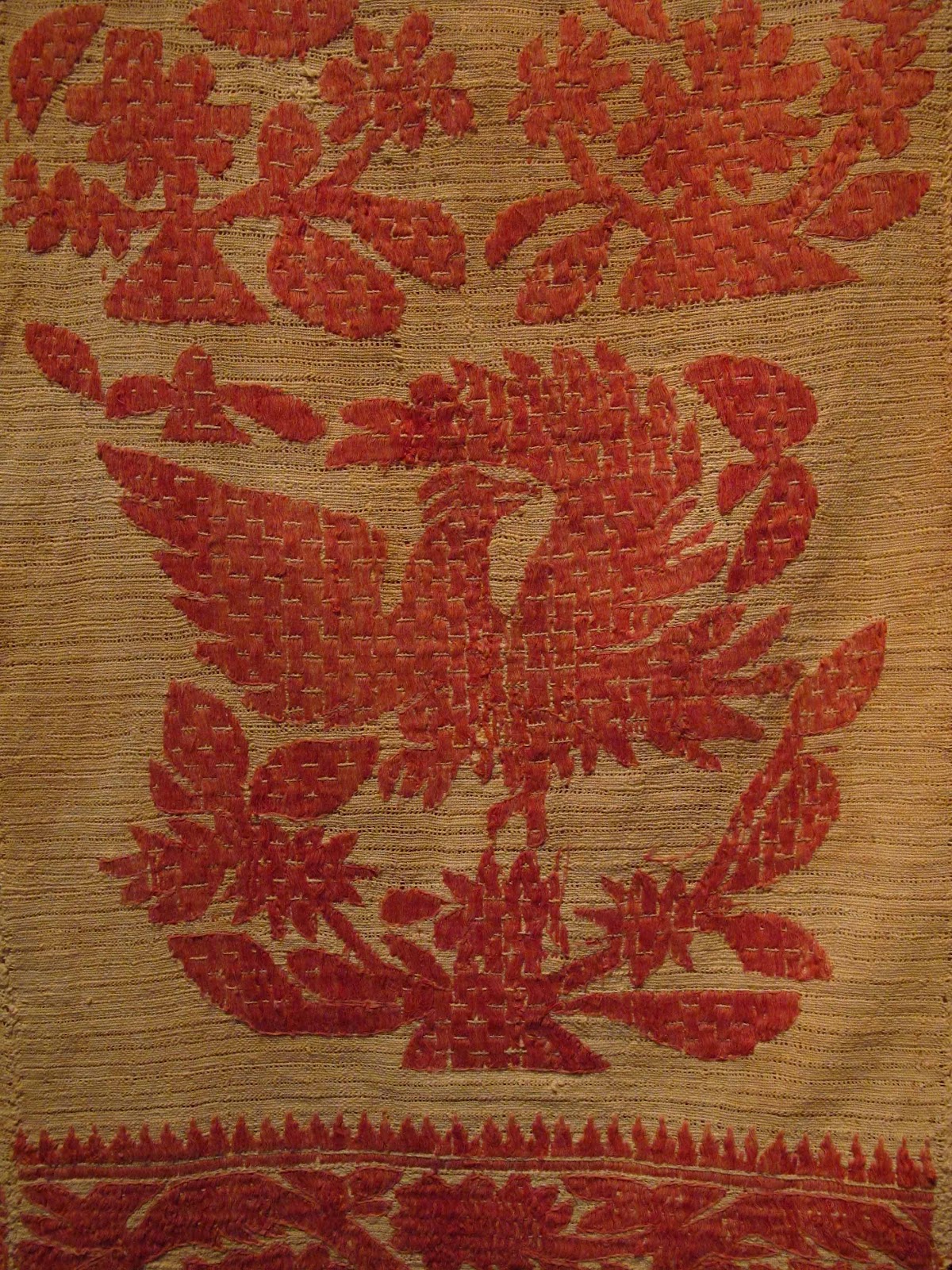
In December of 2012 the Museo Textil de Oaxaca hosted two important exhibitions.  One traditional, called Threads of the cloud people, consisted of textiles from all over the state of Oaxaca dating from the late 19th century to the present; the other consisted of commissioned work called Nuevo diseño textil 2011.  You might think of the second as an extension of the first.  This post will include photos from Threads of the cloud people.  For more photos and a chance to enlarge them to the size of the opening photo, please check out my Picasa photo album.  A following post will cover Nuevo diseño textil 2011.  In the words of Alejandro de Ávila B., curator:

Threads of the cloud people, communal textiles from Oaxaca

The diversity of their materials, styles and designs brings Oaxacan textiles to the forefront among the visual arts of the Americas. In this mountainous, ecologically complex region, where the main ethnic groups call themselves the "cloud people" and "sacred rain's collectivity," many kinds of plants, animals and minerals have been used to obtain fibers and dyestuffs, probably in greater variety than in other areas on this continent. In tandem, woven structures appear to have become more diversified in Oaxaca than in other regions of Mexico and Central America. Many of those fibers, colorants and techniques ceased to be used in the last fifty years. Lost along with them were fine manual skills and a wide repertoire of designs.  The majority of the weavings and embroideries were not produced for commercial purposes, but to be used by the people who made them in the indigenous communities, as well as in Afro-Mexican and Mestizo towns. Intended for the domestic and ritual life of groups who are culturally distinct, huipiles and other garments preserved iconographic and stylistic traits that evoke different historic periods. Maintained alive with those traits was a tradition of narrative that recreates, in some cases, the meaning of the woven figures.

We have selected for this exhibit some outstanding pieces in the collection of the Museo Textil de Oaxaca to illustrate the variety of materials and designs in textiles that were manufactured for peoples' own use in different areas of the state. As we present everyday and ceremonial garments that date from the late 19th to the 21st centuries, we aim to put into perspective a rapid evolution of attire, what we could call the communal fashions of Oaxaca of the last one hundred years. We do not show here weavings or embroideries made for the outside market once tourism took hold; we exclude commercial pieces in order to highlight the sheer diversity and the aesthetic refinement of textiles created by exceptionally talented individuals to dress themselves and their families. In choosing the pieces for the show, we have tried to cover evenly the different ethnic groups in the state, including people of African and European cultural ancestry.

The exhibit is organized in four chronological sections. The first shows the earliest pieces in our holdings, woven during the second half of the 19th century and the early 1900s.  Salient among them is an exceptional rebozo, the only silk weaving that has been preserved from Coyotepec, dyed with the most important dyestuffs in Mesoamerica: cochineal, indigo and shellfish purple. The second section of the show includes pieces that were made in the early decades of the 20th century, when worsted yarn and other industrial manufactures became widespread in southern Mexico.  A beautiful wraparound skirt from Tututepec illustrates the early adoption of machine-spun threads and synthetic dyes, combined with traditional materials.  The third section features weavings and embroideries made in the mid-1900s, a period of drastic change in many communities. A huipil from Choapan, decorated with two techniques historically restricted to Oaxaca, bears witness to the loss of the textile arts in various areas of the state during that period. The fourth section is dedicated to the late 20th century and the most recent decade, which have seen the introduction of acrylic wool and other fibers derived from petroleum. A blouse from Santa Lucía Miahuitlán, embroidered in 2009, attests to the vitality of an elegant and delicate taste for textiles in some of the poorest communities of our country.  The most important exhibit mounted so far in this museum thus ends on a note of hope.

Alejandro de Ávila B.


Friday, July 20, 2012

Casa de la Cultura Oaxaqueña (CCO)


In the mid 60's the former convent of the seven princes was restored into the School of the Arts and Crafts of Oaxaca which later closed in 1971 when the Casa de la Cultura was created, becoming one of the few houses of culture that existed in Mexico.

The restored former convent, now the Casa de la Cultura, retains a courtyard surrounded by arches on two levels, with a beautiful octagonal fountain in the center.

The Casa de la Cultura presents shows and provides space for classes in folk dance and music, and has workshops of plastic arts such as painting, sculpture and folk art.  It is located at the corner of Gonzales Ortega and Colon in the center of the city.

If you visit on Saturday the Casa de la Cultura will be alive with students in music, dance and other arts.  The Casa de la Cultura hosts art exhibitions.  Their Facebook page is http://www.facebook.com/pages/Casa-de-Cultura-Oaxaqueña/157082727689541


Fue a mediados de la década de los años 60 cuando el ex convento de los siete príncipes fue restaurado y convertido en la Escuela de las Artes y Oficios de Oaxaca, en el año 1971 de decide cerrar la escuela debido al poco éxito alcanzado y el edificio es ocupado para la creación de la Casa de la Cultura Oaxaqueña, con ello se convierte una de las pocas Casas de la Cultura que existían en esos años en el país.

El Ex Convento restaurado, hoy Casa de la Cultura, conserva un patio rodeado de arcos en sus dos niveles, con una hermosa fuente octagonal en el centro.


Aquí se representan espectáculos organizados por la Institución Cultural. En los salones adaptados se imparten clases de: danza folklórica y música, también cuenta con talleres de artes plásticas como pintura, escultura y artes populares.  La casa de la cultura se ubica en cruce que hacen las calles de Gonzáles Ortega y Colon en el centro de la ciudad.

Si usted visita el sábado la Casa de Cultura estará vivo con los estudiantes de música, danza y otras artes. La Casa de la Cultura se realizan exposiciones de arte. Su página de Facebook es http://www.facebook.com/pages/Casa-de-Cultura-Oaxaqueña/157082727689541


Thursday, May 31, 2012

Francisco Toledo


Francisco Toledo at an inauguration for his ceramic tiles at Tienda Q
Many consider Francisco Toledo the greatest living artist of Mexico. He has come to be synonymous with Mexico's soul or at least the soul of his beloved state, Oaxaca.  Through him the heritage of his people has been refined and through him has poured into an astonishing array of work. To feel Mexico, immerse yourself in the work of Toledo. 
One of his designs on a kite at the paper factory in San Agustín Etla
Francisco Toledo was born to Zapotec parents in Juchitan, Oaxaca on July 17, 1940. He comes from the same state and indigenous background as Rufino Tamayo, another great painter from Oaxaca.  Both Toledo and Tamayo carry a unique energy in their work identified with the mystical beauty of Oaxaca. Both men borrowed from European and American movements and techniques, but remain firmly independent in their vision shunning the artistic dictates influencing Mexico following the revolution.

In 1950 Toledo began his career in the printing studio of Arturo Garcia Bustos and then went on to study at the Escuela de Bellas Artes de Oaxaca. He went to Mexico City in 1957 where he studied graphic arts under Guillermo Silva Santamaria.  In 1959 Toledo exhibited his work for the first time at the Antonio Souza Gallery.  By the time he was 20, he had taken residence in Europe remaining for five years settling in Paris. By the time he returned to Mexico in 1965, he was already a recognized artist celebrated for his development of the mythic and his sacred sense of life. He integrated himself into the artistic community of Oaxaca, mastering an incredible array of media including lithography, engraving, sculpture, ceramics and painting. He designed tapestries with the weavers of Teotitlan de Valle executing his designs.

A mobile figure laser cut from x-ray film
His reputation spread quickly in the 1970’s. A lot of what we think of as representative of Toledo - cats, dogs, bats, insects  - came out of this period. During this period, he also started to experiment with semi-erotic male figures, often with faces that were like sketches in geometric form similar to ancient masks.  By 1980 his work was so significant that the Museum of Modern Art in Mexico City had a retrospective of his painting.


The world was seduced by the power of his creations bordering on the fantastic fused with the real that resides in nature, and takes on the fantastic when inspired art raises it to the highest degree.  Toledo is a visual poet who looks at the world and notices strange analogies. His art suggests shapes within shapes, and actions have actions within actions. Though Oaxaca is always present beneath the surfaces of his images, he is able to take his surroundings and imbue it with the universal. Through his work we feel unconsciously his own heritage, yet he touches that connecting cord in all of us, that root from which we all sprang.

Toledo designed paper jewelry in San Agustín Etla
His work shows an innate, natural feeling for diverse material through which he expresses complex ideas. His graphic imagination shapes visual thoughts, more than simply being a storyteller.  Since the 1990s he has included more geometric forms in his art.  His fascination with the myths of his people and the nature that appears in their stories shows in the images transformed by his magical imagination into an art in which man is inclusive in the universe.

CASA, San Agustín Etla
In the cargo system characteristic of indigenous pueblo leadership, members of the pueblo have obligations to fulfill for the good of the community. Toledo has given back to the community by being a catalyst and a guardian of the arts. He created the Instituto de Artes Graficas de Oaxaca (IAGO) which has a collection of more than 12,000 volumes dealing with painting, graphics, drawing, sculpture, archeology, design, library science, popular art, textile, ceramics, photography, film, literature, and Mexican art, and a collection of over 6,000 works by Mexican and foreign artists. The IAGO also hosts exhibitions and conferences.  He was also involved in the founding of the Museum de Arte Contemporaneo de Oaxaca (MACO), and the Patronato Pro-Defense y Conservacion del Patrimonio Cultural de Oaxaca which sponsors the Jorge Luis Borges library for the blind, the Alvarez Bravo Center for photography, and the Eduardo Mata music library. In 2006 the Centro de Artes de San Agustín (CASA) in San Agustín Etla opened by his initiative.  At CASA one can study photography, digital graphics, textile design, preservation of heritage, art conservation, and man’s interaction with his environment.  

In Oaxaca it is common to see Toledo on the street especially near the IAGO.  He also is present at some art openings, a frequent occurrence in Oaxaca.  His art is distinctive, easily recognizable, with a certain element that carries over from one media to another as well as from one period to the next.  More of my photos are available on my picasa web album.  For more of his painting I suggest you search the internet under his name for images.

Monday, May 21, 2012

Paseo Juárez el Llano


Paseo Juárez, also known as El Llano, is one of the oldest and largest parks in the centro histórico de Oaxaca. José María Morelos  created "El Llano de Guadalupe", the Plains of Guadalupe, in celebration of triumphs of the Independence movement.  Originally it was a simple grass covered esplanade, with a central fountain and trees.  By 1870, State Governor, Miguel Castro ordered development of the southern end of the garden.  In 1878, State Governor Francisco Meixueiro finished the northern end.  By 1886 the park was completed.  The central fountain was removed in 1894, and replaced with a characteristically national-style monument to Benito Juárez.  In the middle of the 20th century, the park was used for the city zoo, which closed in 1970.  Bronze lions marked the entrances and still stand guard at the corners of the park.  The park is approximately 250 meters long by 75 meters wide with gardens, benches, paths, four fountains, and some of the finest trees in the city.  It hosts civic functions, cultural and artistic festivals, and a lively market on Friday. 


 December 12th the park is filled with family amusements to celebrate the Virgin of Guadalupe.   At the north end of the park is the Shrine of Our Lady of Guadalupe and the Chapel of Bethlehem. The church and hospital of Our Lady of Guadalupe were blessed in 1650, and years later an image of Guadalupe was donated by Bishop Cuevas that miraculously survived a fire in 1665.  In 1821 the Spanish Parliament abolished the Bethlemite Order and the church was given over  to the state government, and began to function as a civilian hospital, then later becoming a leper colony and a shelter for the poor. The temple and the chapel remain open for worship, while the former convent would be used for the offices of the National Institute of Anthropology and History.

In just 24 hours Llano Park can go through wild mood swings from a quiet place to rest in the afternoon or as a place to meet a friend in the evening, to a loud busy market, which comes and goes in a single day.  If you can’t find it at the Friday market, you don’t really need it.  You can get clothes, shoes, jewelry, cosmetics, groceries, hardware, or equip your kitchen.  It’s a great place to eat as well with stands selling tacos of chivo, borrego, arrachera and carnita; tortas; consume; costillas or braised pork ribs; pollo asado; and agua frescas.  If you went to the organic market in Xochimilco before you came here, well everything is available to go, no need to cook tonight. The market has grown to nearly encircle the perimeter creating a packed isle way 600 meters long while the center of the park remains somewhat calm.


For more photos please visit my Picasa web album.

Tuesday, May 1, 2012

Cathedral of Our Lady of the Assumption


The Cathedral of Our Lady of the Assumption (Catedral Metropolitana de Nuestra Señora de la Asunción) is an imposing sight on the Alameda de León in Oaxaca's city center.  The cathedral, whose construction began 1535, had to be extensively rebuilt in 1730 after a series of earthquakes and fires, which explains its solid walls and asymmetrical towers.  The Cathedral is the seat of the Roman Catholic Archdiocese of Antequera, Oaxaca. During construction the Temple of San Juan de Dios served as the cathedral of the diocese. In 1640 the seat of the diocese was transferred to Our Lady of the Assumption. Due to earthquakes in the 16th and 18th centuries, the cathedral had to be reconstructed several times, with the most recent reconstruction beginning in 1702 and finishing in 1733.

Its facade is made of green cantera stone commonly found in Oaxaca's buildings, and the interior is in Neoclassical style. The altar features a bronze statue of Our Lady of the Assumption (Nuestra Señora de al Asunción) made in Italy during the Porfirio era by Tadoini.  The towers of the cathedral are not the originals, which were destroyed in a 1931 earthquake. In the south tower there is a clock donated to Oaxaca by King Fernando VII.  A chapel at the back of the church, left of the altar, houses the revered crucifix of El Señor del Rayo (Our Lord of the Lightning Bolt), the only piece to survive a fire that started when lightning struck the thatch roof of the original structure.  The second chapel on the right contains the remains of the Cross of Huatulco. Against the west wall of the choir is a locally built baroque pipe organ, parts of which date to 1711-1712, restored in 1997. The interior was plundered during the Wars of Reform, so is not as interesting as the intricate exterior.


The cathedral's attractive Baroque façade includes a fine relief of the Assumption of the Virgin Mary above the central door. The heavy, elaborate frame around the picture and the highly stylized wavelike clouds next to the cherubs are distinctive features of Oaxacan Baroque. An uncommon and quite lovely detail is how the Virgin's cape and its folds are depicted in angular lines and facets.  For more views please visit my picasa web album.