Showing posts with label Alejandro de Ávila. Show all posts

Friday, September 7, 2012

Threads of the cloud people, communal textiles from Oaxaca


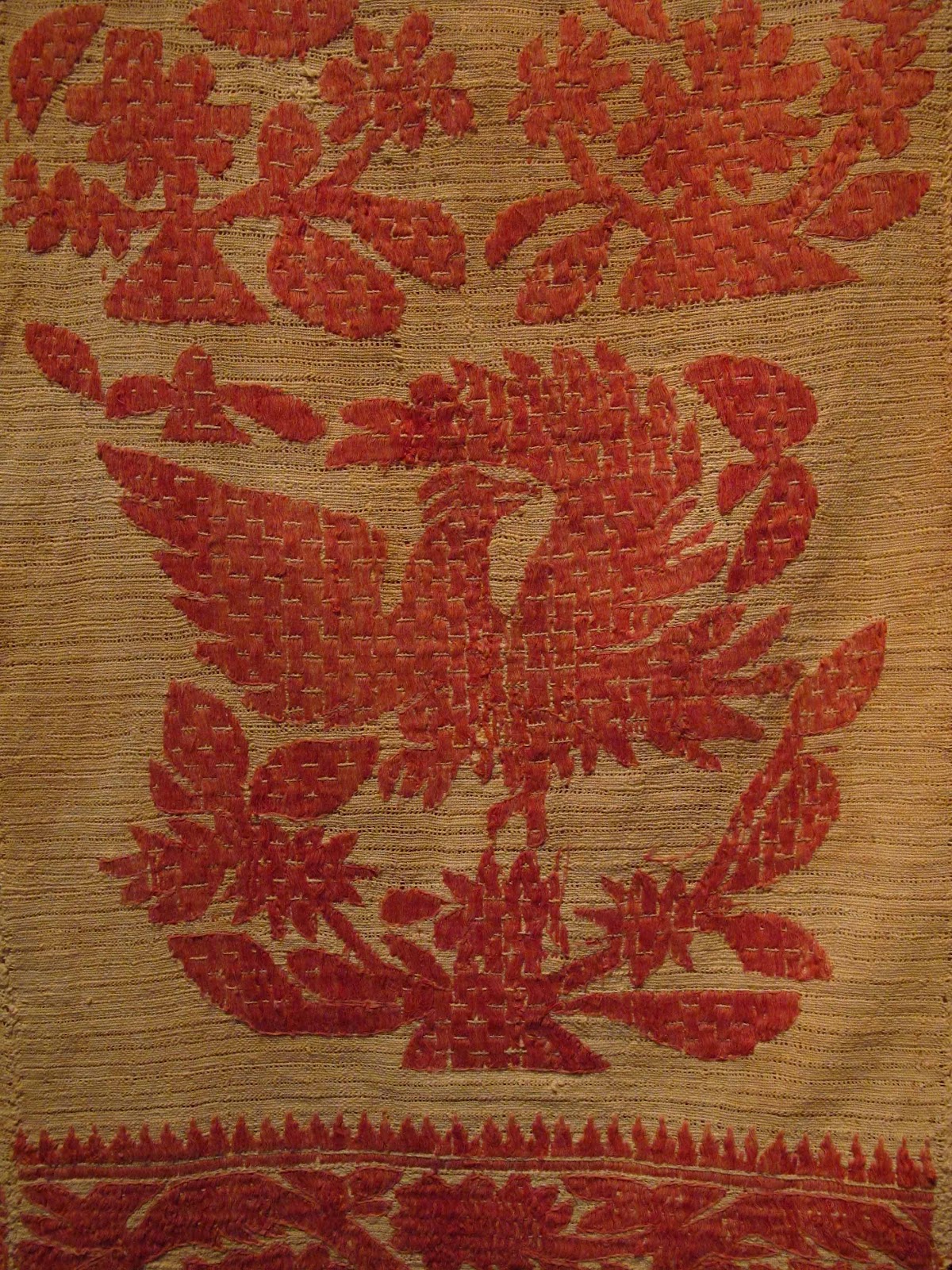
In December of 2012 the Museo Textil de Oaxaca hosted two important exhibitions.  One traditional, called Threads of the cloud people, consisted of textiles from all over the state of Oaxaca dating from the late 19th century to the present; the other consisted of commissioned work called Nuevo diseño textil 2011.  You might think of the second as an extension of the first.  This post will include photos from Threads of the cloud people.  For more photos and a chance to enlarge them to the size of the opening photo, please check out my Picasa photo album.  A following post will cover Nuevo diseño textil 2011.  In the words of Alejandro de Ávila B., curator:

Threads of the cloud people, communal textiles from Oaxaca

The diversity of their materials, styles and designs brings Oaxacan textiles to the forefront among the visual arts of the Americas. In this mountainous, ecologically complex region, where the main ethnic groups call themselves the "cloud people" and "sacred rain's collectivity," many kinds of plants, animals and minerals have been used to obtain fibers and dyestuffs, probably in greater variety than in other areas on this continent. In tandem, woven structures appear to have become more diversified in Oaxaca than in other regions of Mexico and Central America. Many of those fibers, colorants and techniques ceased to be used in the last fifty years. Lost along with them were fine manual skills and a wide repertoire of designs.  The majority of the weavings and embroideries were not produced for commercial purposes, but to be used by the people who made them in the indigenous communities, as well as in Afro-Mexican and Mestizo towns. Intended for the domestic and ritual life of groups who are culturally distinct, huipiles and other garments preserved iconographic and stylistic traits that evoke different historic periods. Maintained alive with those traits was a tradition of narrative that recreates, in some cases, the meaning of the woven figures.

We have selected for this exhibit some outstanding pieces in the collection of the Museo Textil de Oaxaca to illustrate the variety of materials and designs in textiles that were manufactured for peoples' own use in different areas of the state. As we present everyday and ceremonial garments that date from the late 19th to the 21st centuries, we aim to put into perspective a rapid evolution of attire, what we could call the communal fashions of Oaxaca of the last one hundred years. We do not show here weavings or embroideries made for the outside market once tourism took hold; we exclude commercial pieces in order to highlight the sheer diversity and the aesthetic refinement of textiles created by exceptionally talented individuals to dress themselves and their families. In choosing the pieces for the show, we have tried to cover evenly the different ethnic groups in the state, including people of African and European cultural ancestry.

The exhibit is organized in four chronological sections. The first shows the earliest pieces in our holdings, woven during the second half of the 19th century and the early 1900s.  Salient among them is an exceptional rebozo, the only silk weaving that has been preserved from Coyotepec, dyed with the most important dyestuffs in Mesoamerica: cochineal, indigo and shellfish purple. The second section of the show includes pieces that were made in the early decades of the 20th century, when worsted yarn and other industrial manufactures became widespread in southern Mexico.  A beautiful wraparound skirt from Tututepec illustrates the early adoption of machine-spun threads and synthetic dyes, combined with traditional materials.  The third section features weavings and embroideries made in the mid-1900s, a period of drastic change in many communities. A huipil from Choapan, decorated with two techniques historically restricted to Oaxaca, bears witness to the loss of the textile arts in various areas of the state during that period. The fourth section is dedicated to the late 20th century and the most recent decade, which have seen the introduction of acrylic wool and other fibers derived from petroleum. A blouse from Santa Lucía Miahuitlán, embroidered in 2009, attests to the vitality of an elegant and delicate taste for textiles in some of the poorest communities of our country.  The most important exhibit mounted so far in this museum thus ends on a note of hope.

Alejandro de Ávila B.


Saturday, February 11, 2012

Herencia de Moros - Alforjas, Alfombras, y Almohadas


Saddlebags, Rugs, and Pillows

A talega from ta'liqa, 'bag to hang'

From Alejandro de Ávila, curator Museo Textil de Oaxaca (MTO)

As Latin American peoples, we usually recognize we have three cultural roots: the native indigenous societies, the Iberian invaders, and the slaves expatriated from sub-Saharan Africa.  There is a fourth root of which we tend to ignorant, but which is revealed by our language as well as our material culture.  Castilian inherited several non-European words to designate weavings and garments, which we continue to wear, five hundred and twenty years after Isabella and Ferdinand conquered Granada. We refer to terms such as gabán (overcoat), from the Arabic qabā'; chaleco (vest), from the Turkish yalak, and tafetán (taffeta), from the Persian tāftè. Belonging to three different families, these three languages bear characteristic phonological traits that allow us to trace the provenience of lexical items origin borrowed into the old Spanish. The majority of them come from Arabic, which is part of the Afro-Asiatic language family, but we also encounter etymologies involving the Altaic family, to which Turkish belongs, as well as the Iranian branch of the Indo-European family, which includes Persian.

MTO's education director, Eric Chávez.
If we examine in detail the Castilian textile terminology which has Arabic background, we found a curious pattern: many of the words refer to tunics and capes to shield oneself from the sun, protective gear for beasts of burden, and bedding for travel. Let us look at some examples: jubón (tunic), a garment worn by men in Mexico comes from ŷubba; enjaezar (harness), which means ‘to decorate a horse’, derives from ŷahāz; albarda (saddle), the straw filled cushion that protects the backbone of an animal against the friction of the saddle, has varied but little from the original al-bara'a, and almadraque (bed), an old fashioned name for a thin mattress, comes from al-Muttrah. This vocabulary inherited by Spanish originated in the nomadic habits of pastoral societies of western Asia and northern Africa.

A pillow or almohadas, from al-mujadda
Once grains and herds were domesticated twelve thousand years ago, the Mediterranean Levant saw the emergence of a symbiosis between farmers and shepherds, where each sector developed its own technology according to its mode of subsistence. Alluvial soils along the rivers were worked by sedentary farmers, whereas the vast arid landscapes of the mid-latitudes became the habitat of wandering herders. The ecology of the region conditioned the mode of production and shaped their textile technology. Saddlebags (alforjas in Spanish, from the arabic al-jurŷa), double bags which allow the load to be balanced on the back of a animal, are a textile prototype designed for nomadic life. Ingeniously constructed ​​from a single web, they serve to transport the rider’s basic equipment easily and efficiently. Likewise, rugs (alfombras in Spanish, from al-jumra, 'palm mat') and pillows (Spanish almohadas, from al-mujadda 'point where the cheek is supported’) allow a person to sit or lie down comfortably on the floor of a portable dwelling, in the absence of chairs and beds, too bulky and heavy to travel with.

An almofrej or al-mufriš, a storage case.

Recreated in Spain during the Moorish occupation of the Middle Ages, saddlebags and pillows came to the Americas with the conquistadors and their animals, to evoke the peoples of the desert to this day. In this exhibition we show some Mexican and Peruvian examples of both kinds of textiles, together with their woolen equivalents from Central Asia and the Middle East. Today, Oaxacan and Guatemalan saddlebags are woven coarsely of agave, but some antique pieces of cotton (from al-qutn, another Arabic word), have been preserved, soft to the touch and carefully embellished, which echo their old world antecedents. We also display various versions of the talega (ta'liqa, 'bag to hang') and the almofrej (al-mufriš, 'storage case for the road bed'), vital luggage for herders in their endless journeys. Some examples, woven by women Baluchi, Shahsevan, Yünçü, and other nomadic groups of Persia and Anatolia show striking parallels in technique and structure with indigenous Mesoamerican pieces. The itinerant way of life described in several biblical passages, shared ancestrally by Arabs and Jews, favored the emergence of a rich and varied textile artistry, which would resonate across the Atlantic. In weaving links between two hemispheres, we dedicate this exhibit to Alfredo Harp Helú, founder and patron of this museum, the grandson of Lebanese immigrants who arrived in Oaxaca early in the last century and became fabric and clothing manufacturers.

Most of the pieces in the exhibit are from the 19th century.  For a better look at the exhibit please visit my picasa web album.  For the Museo Textil visit http://www.museotextildeoaxaca.org.mx/