Monday, March 11, 2013

El Istmo de Tehuantepec y el vestido de tehuana.


Una Tehuana en el mercado 

El Istmo de Tehuantepec representa la distancia más corta entre el Golfo de México y el Océano Pacífico. El Istmo de Panamá es más corto pero se conecta el mar Caribe al océano Pacífico. Antes de la apertura del Canal de Panamá, era una ruta de transporte principal conocida como la Ruta de Tehuantepec. El nombre proviene del náhuatl, tecuani-tepec, que significa cerro del jaguar.  En su punto más estrecho, el istmo es de 192 km a través del Golfo de México a la Laguna Superior en la costa del Pacífico.  La Sierra Madre se convierte en una meseta, cuya altitud en el punto más alto, Chivela Pass, es de 224 m. El istmo y la brecha entre la Sierra Madre de Oaxaca y la Sierra Madre de Chiapas dividen geográficamente Norteamérica de Centroamérica. Geológicamente, la división entre la placa tectónica de Norteamérica y de Centroamérica, se encuentra en Guatemala, más al sur que el Istmo de Tehuantepec. 


The Isthmus of Tehuantepec represents the shortest distance between the Gulf of Mexico and the Pacific Ocean. The Isthmus of Panama is shorter but it connects the Caribbean Sea to the Pacific Ocean.  Prior to the opening of the Panama Canal, it was a major shipping route known as the Tehuantepec Route.  The name comes from the Nahuatl, tecuani-tepec, which means jaguar hill. At its narrowest point, the isthmus is 192 km across from the Gulf of Mexico to Laguna Superior on the Pacific coast.  The Sierra Madre becomes a plateau, whose elevation at the highest point, Chivela Pass, is 224 m.  The isthmus and the break between the Sierra Madre de Oaxaca and the Sierra Madre de Chiapas geographically divide North America from Central America.  Geologically, the division between North America and Central America tectonic plates lies in Guatemala, farther south than the Isthmus of Tehuantepec.

A Tehauana riding a moto-taxi

La Selva Zoque en la región centro-oriental del istmo es un área de gran importancia ecológica, la mayor área de selva tropical en México con la mayor parte de la biodiversidad terrestre en México. La región del istmo está caliente y palúdica, con excepción de las zonas abiertas, donde los vientos del Océano Pacífico hacen el clima relativamente fresco y saludable. La precipitación media anual en el Atlántico o el lado norte es de cuatro metros. El lado Pacífico tiene un clima más seco. La estrechez del istmo, y la brecha en la Sierra Madre, permita que los vientos alisios desde el Golfo de México a soplar a través del Pacífico. Periódicamente, los vientos fuertes soplan a través del Paso de Chivela y sobre el Golfo de Tehuantepec en la Costa del Pacífico.  Este viento se conoce como Tehuano.

The Selva Zoque in the eastern-central region of the isthmus is an area of great ecological importance, the largest remaining area of tropical rainforest in Mexico with the majority of the terrestrial biodiversity in Mexico. The isthmus region is hot and malarial, except for open areas, where the winds from the Pacific Ocean make the weather comparatively cool and healthy. The annual rainfall on the Atlantic or northern side is four meters.  The Pacific side has a drier climate. The narrowness of the isthmus, and the gap in the Sierra Madre, allow the trade winds from the Gulf of Mexico to blow through to the Pacific. Periodically, strong winds blow through the Chivela Pass and out over the Gulf of Tehuantepec on the Pacific coast. This wind is known as the Tehuano.

An antique 'painted' huipil

An example of a Tehauana dress
La población está compuesta en su mayoría por indígenas zapotecos. Las mujeres dominan en los mercados de Tehuantepec. Conocido como "Tehuanas", estas mujeres son conocidas en todo México por sus coloridos vestidos tradicionales, personalidades asertivas, y relativamente relaciones de igualdad con los hombres. Frida Kahlo adoptaba el vestido tradicional de tehuana como una declaración de solidaridad con estas mujeres. Para velas y otros eventos especiales, las mujeres visten el traje tradicional de Tehuana, que consiste en la ropa pesadamente bordada complementada con cantidades grandes de la joyería de oro.  Esta joyería a menudo contiene monedas antiguas de oro y aretes de filigrana de oro.  La enagua es encaje, mientras la falda y huipil se bordan terciopelo negro. La cubierta de la cabeza, se requiere por el clero para entrar en la iglesia, fue vestido de un niño de encaje usa sobre la cabeza en una de dos maneras, con el cuello del vestido usado alrededor de la cabeza o con la falda lleva como una corona (vea la fotos).  Haga clic aquí para visitar el Museo Textil de Oaxaca.

Antique embroidery

Antique embroidery

The population is composed mostly of indigenous Zapotec people. The women dominate in the markets of Tehuantepec. Known as "Tehuanas", these women are known throughout Mexico for their colorful traditional dress, assertive personalities, and relatively equal relations with men.  Frida Kahlo adopted the traditional dress of Tehuana to express solidarity with these women.  For velas and other special events, women wear the traditional dress of Tehuana, which consists of heavily embroidered velvet garments accessorized with gold jewelry containing old coins and gold filigree earrings. The underskirt is lace while the skirt and huipil are embroidered black velvet.  The head covering, required by the clergy to enter the church, was a lace child’s dress worn over the head in one of two ways, with the top of the dress worn around the head or with the skirt worn as a crown (see photos). For more photos please visit my Picasa web album.
Click here for a visit to the Museo Textil de Oaxaca


Monday, February 25, 2013

Casa Crespo and La Teca

Casa Crespo


Casa Crespo offers classic Oaxacan cooking done to a high standard.  They also have a roof top deck with the finest view of the Santo Domingo.


Casa Crespo is owned by Oscar Carrizosa who provides cooking classes in English.  Some favorites from his menu include sopa de lentejas con plátano macho, piña, y tocino (lentil soup with plantains, pineapple and bacon), caldo de piedra con camarón y pescado (a pre-Hispanic soup of shrimp and fish cooked with hot river stones), pipian verde (fish of the day in a pumpkin seed mole), Chichilo mole (an old recipe using endemic chilhuacle chiles), helado de chocolate (homemade chocolate ice cream sprinkled with guajillo chile powder), and sorbete de mezcal y sal de gusanitos (mescal sorbet topped with agave warms and chile powder).  They are located at Allende 107, between Alcalá and García Vigil.  Casa Crespo's website is here.


La Teca


La Teca also offers classic Oaxacan cooking from the Isthmus of Tehuantepec done to the highest standard. It is a small place (only four tables inside) in the Colonia Reforma with a lovely garden with five or six more tables where they can accommodate groups. They are located at Violetas 200A.  The owner and chief cook at La Teca is Sra. Deyanira Aquino, born and raised in the Isthmus.  Women of the region are called 'tecas'--from Tehuantepec--hence the name of the restaurant.  Their tasting menu is a great choice if you have a group of four or more. It starts with garnachas then continues with an assortment of tamales.  The menu often includes purée de papa, estilo Istmeño (potatoes, coarsely mashed and then baked, Isthmus style),  asado de puerco con mole (pork roasted with mole, from Tehuantepec), estofado de bodas, and usually a mole served by itself.  Since it's a bit of a hike from the centro it's advised to make reservations, phone 01.951.515.0563.


asado de puerco con mole


For more photos please visit my Picasa web album.


Thursday, February 21, 2013

San Mateo del Mar


San Mateo del Mar, home to the Huave people, is located on a back road on the long sandspit between the Gulf of Tehuantepec and the Laguna Superior.  The Huave have inhabited the Isthmus of Tehuantepec for more than 3000 years, preceding the Zapotec people. The Huave may have migrated from the Nicaraguan Pacific coast and settled around Jalapa del Marqués on the Isthmus.  The more-numerous Zapotecs, invading around 1375, forced them to the edges of the lagoons, where they now live.  Today they inhabit several villages most notably San Mateo del Mar, in the Tehuantepec District, and Santa María del Mar, San Dionisio and San Francisco del Mar, in the Juchitán District.  They trade marine products with their inland neighbors. According to the 2000 census, 13,687 people declared themselves to be Huave speakers. The Huave people of San Mateo del Mar – who call themselves Ikoots, meaning "us" – refer to their language as ombeayiiüts, meaning "our language". Generally ignored and neglected by everyone, the Huaves hold on to many pre-conquest beliefs.


San Mateo del Mar, el hogar de los huaves, está situado en una carretera secundaria en el banco de arena de largo entre el Golfo de Tehuantepec y la Laguna Superior. Los huaves han habitado en el Istmo de Tehuantepec desde hace más de 3000 años, antes de los zapotecos.  Los huaves puedieron haber emigrado de la costa del Pacífico de Nicaragua y se establecieron alrededor de Jalapa del Marqués en el Istmo.  Los zapotecos más numerosos, invadiearon alrededor de 1375, lo cual los obligó establecerse en las orillas de las lagunas, donde ahora viven.  Hoy habitan varios pueblos más notablemente San Mateo del Mar, en el distrito de Tehuantepec, y Santa María del Mar, San Dionisio y San Francisco del Mar, en el distrito de Juchitán. Comercializan productos marinos con sus vecinos interiores. Según el censo de año 2000, 13,687 personas declaran que se fueron hablante de Huave.  La gente huave de San Mateo del Mar - que se llaman Ikoots, que significa "nosotros" - se refieren a su lengua como ombeayiiüts, que significa "nuestra lengua".  Por lo general ignorados y olvidados por todos, los huaves se aferran a muchas pre-conquista creencias.


The women of the family of Justina Oviedo, featured in The Great Masters of Mexican Folk Art, are backstrap weavers.  Their weavings incorporate images from their surroundings, like crabs, turtles, fish, and cranes.  In the pictures Justina is working on a weaving that is double sided with completely different colors and designs on each side.  The other woman is close to completing a piece that she wove from each end towards the middle.  It will become two huipils.  There is also a video of her while she is weaving.

Las mujeres de la familia de Justina Oviedo, que apareció en The Great Masters of Mexican Folk Art, son tejedoras de telar de cintura.  Sus tejidos incorporan imágenes de su entorno, como cangrejos, tortugas, peces y grullas.  En los cuadros Justina trabaja en un tejido que es doble cara con diferentes colores y diseños en cada lado.  La otra mujer está cerca de completar una pieza que ella tejió desde cada extremo hacia el centro. Se convertirá en dos huipiles. También hay un video de ella mientras ella está tejiendo.


There are more photos on my Picasa web album.

Sunday, February 10, 2013

Templo del Carmen Alto


Cuando llegaron los españoles a Huaxyacac se encontraron en este sitio, un templo mexica consagrado a Centeotl la deidad del maíz. Recuérdese que esta ciudad fue fundada por los aztecas en el año de 1486 y que en el Cerro del Fortín construyeron una guarnición militar, pero en las faldas se asentó un pequeño poblado mexica, en el que vivian los familiares de los soldados.

En este tiempo, los primeros pobladores españoles de la ciudad establecieron sitios para el culto cristiano. Uno de ellos fue la ermita de la Santa Veracruz, ubicada en este mismo lugar que fuera un importante centro prehispánico. La ermita sustituyó al gran Teocalli de Huaxyacac, donde la ciudad indígena celebraba, cada mes de julio, la gran Fiesta de los Señores en la que se realizaba el sacrificio de una doncella en honor a Centeótl, Diosa del Maíz y la Agricultura. La festividad se cristianizó y se transformó en la actual fiesta de la Guelaguetza o Lunes del Cerro, la cual coincide con las fiestas en honor a la Virgen del Carmen.


El hombre de la publicidad
Los españoles destruyeron la pirámide de Centeotl y con sus piedras edificaron una pequeña ermita dedicada a la santa Vera Cruz. Pero en el año de 1769, los padres carmelitas construyeron el templo y el convento llamado "El Carmen Alto", toda vez que era exclusivo para españoles, porque el otro templo llamado "Del Carmen Bajo", era para los mestizos y los mulatos, los indígenas tenían sus propios templos en la parte Sur de la ciudad. En los trescientos años de la Colonia el sistema de castas era feroz y muy estricto.

El convento, hacia 1856, tras la secularización de las propiedades de la iglesia, pasó a pertenecer al Gobierno Federal; por estos tiempos fue usado para cárcel y cuartel. En 1889 lo adquirió el obispo Eulogio G. Gillow, quien lo restauró para instalar la residencia episcopal; también fue ocupado para un colegio seminario. En 1910 fue escuela nocturna para obreros y escuela primaria superior.


 La Calenda para el Dios de Paradura del Niño

En 1925 pasó nuevamente a ser propiedad federal. Actualmente, en lo que fue el claustro, están instaladas las oficinas del Registro Civil del estado. En sus demás anexos funcionan centros escolares y oficinas federales. El templo se distingue, respecto a los demás templos de Oaxaca, por su pórtico, cuya función es preparar el ingreso a la nave principal.


En el primer domingo de enero es el Dios de Paradura del Niño (Epifanía). Se celebra en todas las iglesias católicas, pero hay una especial Calenda (procesión) en la iglesia del Carmen Alto. La procesión discurre por el centro de la ciudad y el zócalo capitalino y termina en la iglesia. Después de misas dulces se dan a los niños. Todo termina con una exhibición de fuegos artificiales en el Plazuela de Carmen Alto en el lado sur de la iglesia.


When the Spaniards arrived in Huaxyacac they found on this site, a Aztec temple devoted to Centeotl the deity of the corn. It should be remembered that the city was founded by the Aztecs in the year of 1486 and they had built a military garrison on the Hill of the Fortin, and on the lower slopes they established a small Aztec village for the families of the soldiers.


At this time, the first Spanish settlers of the city established sites for Christian worship. One of them was the chapel of Santa Veracruz, located in the same place that was an important pre-hispanic center. The chapel replaced the great Teocalli of Huaxyacac, where each month of July, the indigenous city had celebrated the great Feast of the lords in which there was the sacrifice of a maiden in honor of Centeótl, the goddess of corn and agriculture. The festival was Christianized and transformed in the current holiday of the Guelaguetza or Monday of the Hill, which coincides with the holidays which honor the Virgin of Carmen.


The Spaniards destroyed the pyramid Centeotl and with its stone built a small chapel dedicated to the Santa Vera Cruz. But in the year of 1769, the Carmelite fathers constructed the temple and the convent called 'Carmen Alto', at that time that it was exclusive for Spanish, the other temple called 'Carmen Bajo' was for the mestizos and mulattoes; indigenous peoples had their own temples in the southern part of the city. In the three hundred years of colonial rule the caste system was fierce and very strict.


The convent, about 1856 after the secularization of the properties of the church, passed to the Federal Government and by these times it was occupied by a jail and barracks. In 1889 the bishop Eulogio G acquired and restored it, installing the Episcopal residence. It was also was occupied by a school in 1910 for workers in the evening and a as top primary school.


In 1925 it became again a federal property. Currently, in what was the cloister, are the offices of the Civil Registry. In its other annexes operate schools and federal offices.  The temple is distinguished, in relation to other temples of Oaxaca, by its portico, whose function is to prepare for the entry to the main nave.


Girls want to have fun too

Note the tree and all the cinders in the air;  and wear eye projection and old clothes.


On the first Sunday in January is the Paradura del Niño Dios (Epiphany).  This is celebrated in all catholic churches, but there is a special Calenda (procession) at the Carmen Alto church. The procession winds around downtown and the zócalo and ends at the church. After mass sweets are given to the children.  It all ends with a display of fireworks in the Plazuela de Carmen Alto on the south side of the church.


An angel after being launched


My Picasa web album is here and there are other fireworks pictures, some from Carmen Alto in previous years here.

Monday, February 4, 2013

Santa Rosa


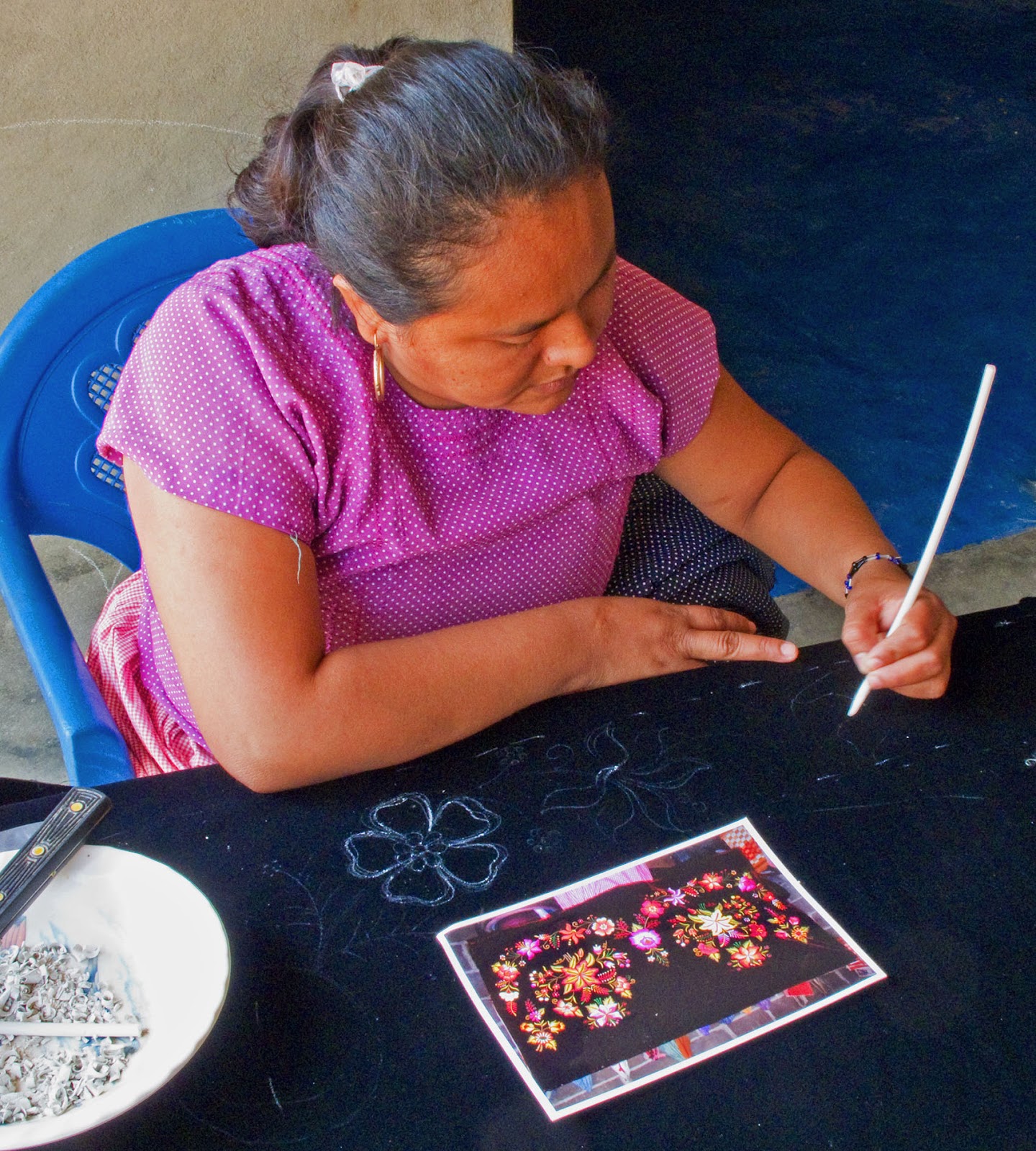
No muy lejos de Tehuantepec está el pequeño pueblo de Santa Rosa, en el que casi todas las mujeres pasan parte del día bordando blusas encargadas por dueños de tiendas y mujeres de los pueblos vecinos. Hay dos tipos diferentes del bordado, flores hechas por modelos de mano y geométricos hechos con pequeñas máquinas de coser antiguas. Un huipil solo puede usar uno o el otro tipo de bordado o combinar ambos en una sola pieza.  Las imágenes muestran ambos tipos de bordados realizados y las imágines también mostrar otra mujer que trabaja como caricaturista para dibujar los patrones sobre terciopelo utilizando creyón.


Not far from Tehuantepec is the little village of Santa Rosa. Here many of the women spend part of the day embroidering huipils that are commissioned by shop owners and women from the neighboring towns.  There are two different types of embroidery, flowers done by hand and geometric patterns done on small antique sewing machines.  A single huipil may use one or the other type of embroidery or combine both on a single piece.  The pictures show both types of embroidery being made and pictures also show another woman who works as a cartoonist to draw the patterns on the velvet by using crayon. 


En 1851 Isaac Merritt Singer inventó la primera máquina de coser práctica del mundo. Esta máquina tenía una aguja de ojo derecho y un servicio de transporte transversal, un brazo voladizo, una mesa para apoyar el paño, un prensatelas para sujetar el material contra el movimiento ascendente de la aguja y una rueda alimentadora rugosa que se extiende a través de una ranura en la tabla. Movimiento fue comunicada al brazo de la aguja y transporte por medio de engranajes. También tuvo la idea de utilizar un pedal similar de una rueca; otras máquinas en el tiempo utilizan una manivela para generar energía.


In 1851 Isaac Merritt Singer invented the world’s first practical sewing machine.  This machine had a straight eye needle and a transverse shuttle, an overhanging arm, a table to support the cloth, a presser foot to hold the material against the upward stroke of the needle, and a roughened feed wheel extending through a slot in the table. Motion was communicated to the needle arm and shuttle by means of gears. He also had the idea of using a treadle similar to that of a spinning wheel; other machines at the time used a hand crank to generate power.


I have more pictures on my Picasa web album.