|
| Una Tehuana en el mercado |
El Istmo de
Tehuantepec representa la distancia más corta entre el Golfo de México y el
Océano Pacífico. El Istmo de Panamá es más corto pero se conecta el mar Caribe
al océano Pacífico. Antes de la apertura del Canal de Panamá, era una ruta de
transporte principal conocida como la Ruta de Tehuantepec. El nombre proviene
del náhuatl, tecuani-tepec, que significa cerro del jaguar. En su punto más estrecho, el istmo es
de 192 km a través del Golfo de México a la Laguna Superior en la costa del
Pacífico. La Sierra Madre se
convierte en una meseta, cuya altitud en el punto más alto, Chivela Pass, es de
224 m. El istmo y la brecha entre la Sierra Madre de Oaxaca y la Sierra Madre
de Chiapas dividen geográficamente Norteamérica de Centroamérica.
Geológicamente, la división entre la placa tectónica de Norteamérica y de
Centroamérica, se encuentra en Guatemala, más al sur que el Istmo de
Tehuantepec.

The Isthmus of Tehuantepec represents the shortest distance
between the Gulf of Mexico and the Pacific Ocean. The Isthmus of Panama is
shorter but it connects the Caribbean Sea to the Pacific Ocean. Prior to the opening of the Panama
Canal, it was a major shipping route known as the Tehuantepec Route. The name comes from the Nahuatl,
tecuani-tepec, which means jaguar hill. At its narrowest point, the isthmus is
192 km across from the Gulf of Mexico to Laguna Superior on the Pacific coast. The Sierra Madre becomes a plateau,
whose elevation at the highest point, Chivela Pass, is 224 m. The isthmus and the break between the Sierra
Madre de Oaxaca and the Sierra Madre de Chiapas geographically divide North
America from Central America.
Geologically, the division between North America and Central America
tectonic plates lies in Guatemala, farther south than the Isthmus of
Tehuantepec.
 |
| A Tehauana riding a moto-taxi |
La Selva Zoque en la
región centro-oriental del istmo es un área de gran importancia ecológica, la
mayor área de selva tropical en México con la mayor parte de la biodiversidad
terrestre en México. La región del istmo está caliente y palúdica, con
excepción de las zonas abiertas, donde los vientos del Océano Pacífico hacen el
clima relativamente fresco y saludable. La precipitación media anual en el
Atlántico o el lado norte es de cuatro metros. El lado Pacífico tiene un clima
más seco. La estrechez del istmo, y la brecha en la Sierra Madre, permita que
los vientos alisios desde el Golfo de México a soplar a través del Pacífico.
Periódicamente, los vientos fuertes soplan a través del Paso de Chivela y sobre
el Golfo de Tehuantepec en la Costa del Pacífico. Este viento se conoce como Tehuano.
The Selva Zoque in the eastern-central region of the isthmus
is an area of great ecological importance, the largest remaining area of
tropical rainforest in Mexico with the majority of the terrestrial biodiversity
in Mexico. The isthmus region is hot and malarial, except for open areas, where
the winds from the Pacific Ocean make the weather comparatively cool and
healthy. The annual rainfall on the Atlantic or northern side is four
meters. The Pacific side has a
drier climate. The narrowness of the isthmus, and the gap in the Sierra Madre,
allow the trade winds from the Gulf of Mexico to blow through to the Pacific.
Periodically, strong winds blow through the Chivela Pass and out over the Gulf
of Tehuantepec on the Pacific coast. This wind is known as the Tehuano.
 |
| An antique 'painted' huipil |
 |
| An example of a Tehauana dress |
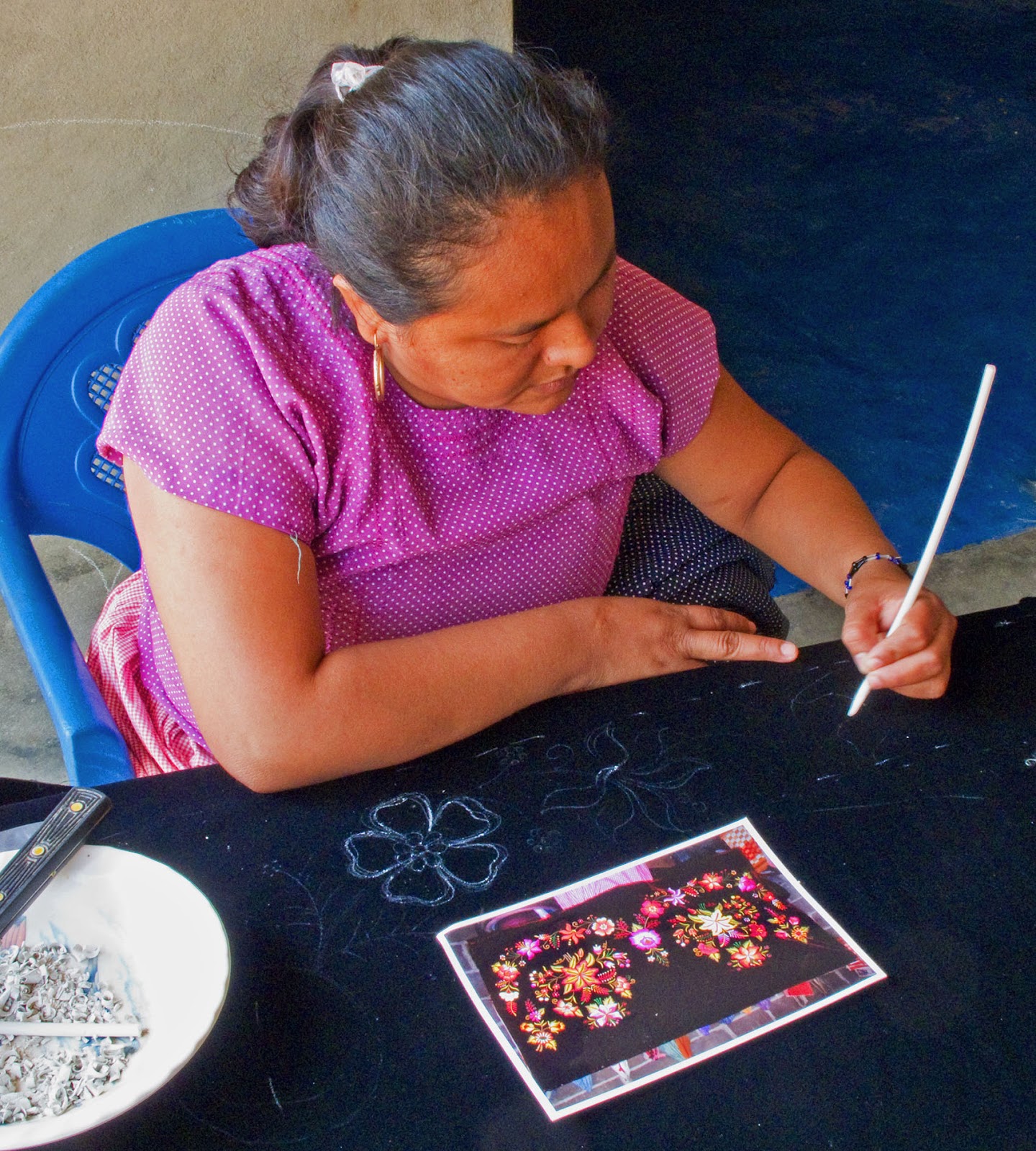
La población está
compuesta en su mayoría por indígenas zapotecos. Las mujeres dominan en los
mercados de Tehuantepec. Conocido como "Tehuanas", estas mujeres son
conocidas en todo México por sus coloridos vestidos tradicionales,
personalidades asertivas, y relativamente relaciones de igualdad con los
hombres. Frida Kahlo adoptaba el vestido tradicional de tehuana como una
declaración de solidaridad con estas mujeres. Para velas y otros eventos
especiales, las mujeres visten el traje tradicional de Tehuana, que consiste en
la ropa pesadamente bordada complementada con cantidades grandes de la joyería
de oro. Esta joyería a menudo
contiene monedas antiguas de oro y aretes de filigrana de oro. La enagua es encaje, mientras la falda
y huipil se bordan terciopelo negro. La cubierta de la cabeza, se requiere por
el clero para entrar en la iglesia, fue vestido de un niño de encaje usa sobre
la cabeza en una de dos maneras, con el cuello del vestido usado alrededor de
la cabeza o con la falda lleva como una corona (vea la fotos).
 |
| Antique embroidery |
 |
| Antique embroidery |

The population is composed mostly of indigenous Zapotec
people. The women dominate in the markets of Tehuantepec. Known as
"Tehuanas", these women are known throughout Mexico for their
colorful traditional dress, assertive personalities, and relatively equal
relations with men. Frida Kahlo
adopted the traditional dress of Tehuana to express solidarity with these
women. For velas and other special
events, women wear the traditional dress of Tehuana, which consists of heavily
embroidered velvet garments accessorized with gold jewelry containing old coins
and gold filigree earrings. The underskirt is lace while the skirt and huipil
are embroidered black velvet. The
head covering, required by the clergy to enter the church, was a lace child’s
dress worn over the head in one of two ways, with the top of the dress worn
around the head or with the skirt worn as a crown (see photos). For more photos please visit my Picasa web album.
Click here for a visit to the Museo Textil de Oaxaca.
Click here for a visit to the Museo Textil de Oaxaca.