Tuesday, December 25, 2012

La Noche de los Rabanos, reprise 2012

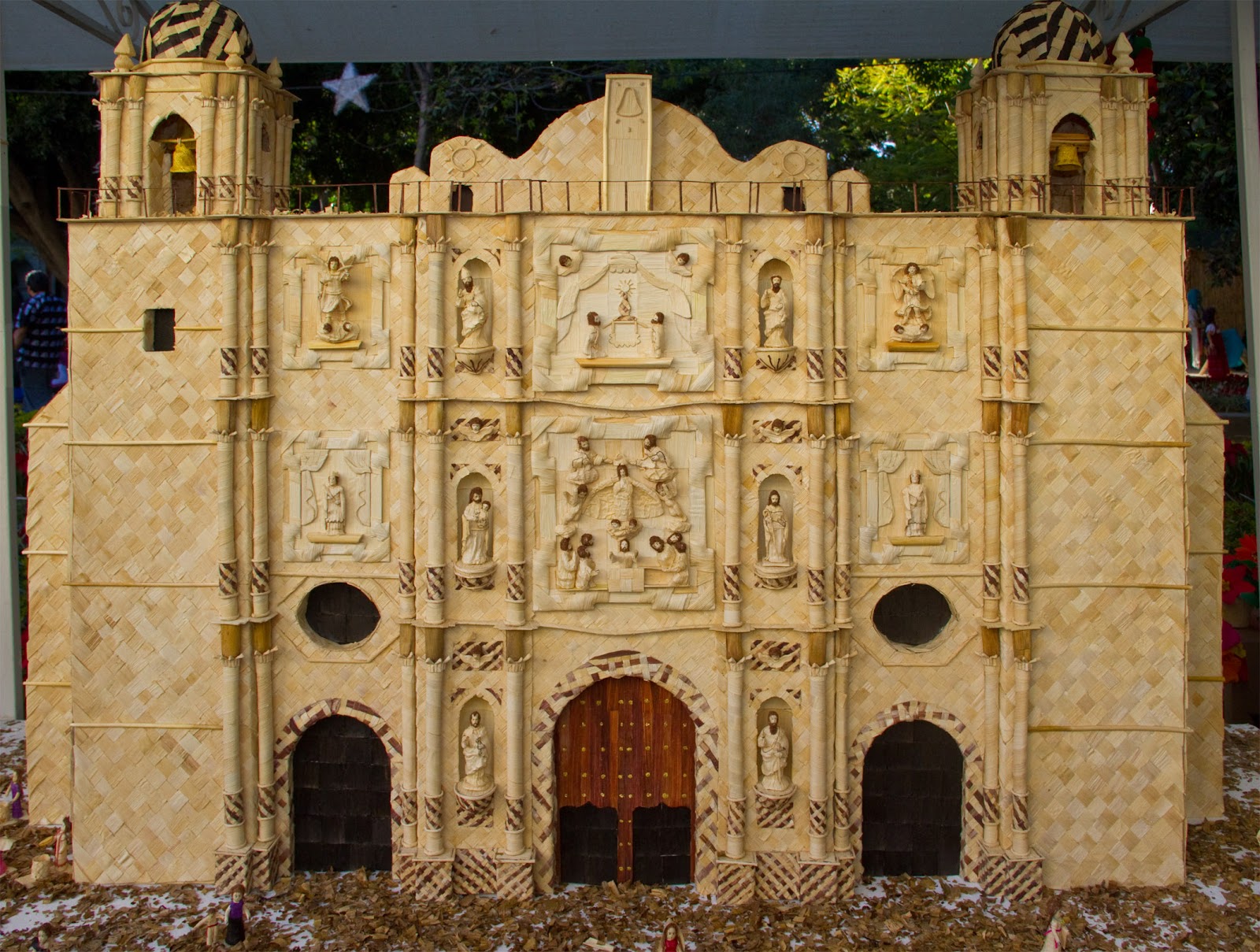
Here are a few shots from the 2012 La Noche de los Rabanos.  There are three major categories, radishes, dried flowers, and corn husks.  Oh yes, the mandatory 'fuegos artificiales' or fireworks.  Sorry there's no sound, sort of dull that way.


First a dried flower figure
Doña Rosa
Don Quixote
Lucha Libre
Frida Kahlo
El dios de los muertos
Fantasy figures
A new idea for your next year's tree

They work on the corn husk figures year round and add to things year by year making the results quite elaborate and spectacular.
World's largest chica banda


La Catedral en el año 1887 (note the detail in the statues below)


The full scale stone version is so much better for fireworks
Nice that there was a moon out


For a closer look with more photos please visit my Picasa Web Album.  I have a earlier post HERE along with another couple of web albums HERE and HERE from prior years.

Saturday, December 22, 2012

Virgen de Guadalupe


In Oaxaca in December, before one can arrive at La Noche Buena, Christmas Eve you must traverse many other festivals.  On December 8th there is la fiesta de La Virgen de Juquila, the Feast of the Virgin of Juquila.  On December 12th there is la fiesta de La Virgen de Guadalupe, the Feast of the Virgin of Guadalupe, celebrated throughout Mexico.  Starting on December 16th are the first of nine traditional Posadas, one each night, including Christmas Eve.  On December 18th there is la fiesta de La Virgen de la Soledad, the Feast of the Virgin of Solitude, the patron saint of Oaxaca.  On December 23rd there is the La Noche de los Rábanos, or Night of the Radishes. Then finally on December 24th we come to La Noche Buena, Christmas Eve.  Afterwards there is New Years Eve; then on the first Sunday in January, the Paradita del Niño Dios; on January 6th, the feast of the Three Kings; and finally on Februray 2nd the Christmas season ends with La Candelaria or purification of the Virgin and the blessing of the infant Jesus. But this post is about Nuestra Señora de Guadalupe.

Nuestra Señora de Guadalupe, also known as the Virgen de Guadalupe is a celebrated Roman Catholic icon of the Virgin Mary and revered as the patron saint and Queen of all México. In Oaxaca there are many activities associated with this day, some religious such as the calendas or religious processions, as well as music, fireworks and the carnival rides.  


Now for a bit of history mixed with folklore.  Two accounts, published in the 1640s, one in Spanish, one in Nahuatl, tell how, while walking from his village to Mexico City in the early morning of December 9, 1531 on the Feast of the Immaculate Conception, the peasant Juan Diego saw on the slopes of the hill of Tepeyac a vision of a girl of fifteen or sixteen years of age, surrounded by light. Speaking to him in Nahuatl, the local language, she asked that a church be built at that site, in her honor.  Juan Diego recognized her as the Virgin Mary. Diego told his story to the Spanish Archbishop, Fray Juan de Zumárraga, who instructed him to return to Tepeyac, and ask the lady for a miraculous sign to prove her identity. The first sign was the healing of Juan's uncle. The Virgin told Juan Diego to gather flowers from the top of the hill of Tepeyac. Although it was December, Juan Diego found Castilian roses, not native to Mexico, at the usually barren hilltop. The Virgin arranged them in his peasant cloak. When Juan Diego opened the cloak before Bishop Zumárraga on December 12, the flowers fell to the floor, and in their place was the image of the Virgin of Guadalupe, miraculously imprinted on the fabric. The Basílica de Nuestra Señora de Guadalupe was built near the location where the Virgen appeared to Juan Diego. Construction of the old basilica began in 1531 and was not finished until 1709.  The devotion to la Nuestra Señora de Guadalupe grew to be so important that in 1754 a papal bull was issued proclaiming the Virgin of Guadalupe as the Patroness and Protector of New Spain. In 1810 she was adopted as the symbol of Mexican Independence and in 1904 Pope Pius X elevated the church built on the site to the category of basilica.


From Patricia Harrington, "The Aztecs ... had an elaborate, coherent symbolic system for making sense of their lives. When this was destroyed by the Spaniards, something new was needed to fill the void and make sense of New Spain ... the image of Guadalupe served that purpose."

The Conquistador, Hernán Cortés, was a native of Extremadura, in Spain, home to Our Lady of Guadalupe. By the 16th century the Extremadura Guadalupe, a statue of the Virgin was already a national icon. It was found at the beginning of the 14th century when the Virgin appeared to a humble shepherd and ordered him to dig at the site of the apparition. The recovered Virgin then miraculously helped to expel the Moors from Spain, and her small shrine evolved into the great Guadalupe monastery. One of the more remarkable attributes of the Guadalupe of Extremadura is that she is dark, like the Americans, and thus she became the perfect icon for the missionaries who followed Cortés to convert the natives to Christianity.  According to secular history, in 1555 Bishop Alonso de Montúfar commissioned a Virgin of Guadalupe from a native artist, who gave her the dark skin which his own people shared with the famous Extremadura Virgin.  Whatever the connection between the Mexican and her older Spanish namesake, the fused iconography of the Virgin and the indigenous Nahua goddess Tonantzin provided a way for 16th-century Spaniards to gain converts among the indigenous population, while simultaneously allowing 16th century Mexicans to continue the practice of their native religion.


Guadalupe continues to symbolize a mixture of the cultures which blended to form Mexico, both racially and religiously, "the first mestiza", or "the first Mexican".  As the Christians built their first churches with the rubble and the columns of the ancient pagan temples, so they often borrowed pagan customs for their own cult purposes. Guadalupe is a "common denominator" uniting Mexicans who are composed of a vast patchwork of differences – linguistic, ethnic, and class-based.  The Virgin of Guadalupe is the bond that binds this disparate nation into a whole. In 1974 Nobel Literature laureate Octavio Paz wrote, "the Mexican people, after more than two centuries of experiments, have faith only in the Virgin of Guadalupe and the National Lottery".

All of the area around the Llano Park in front of the Iglesia de Guadalupe is filled with carnival rides, puestos selling all sorts of things especially food, and special attractions for children.  The following is a montage of the rides in Llano Park.  Please visit my Picasa Web Album for more photos.


Saturday, December 15, 2012

El Baile


El baile “Flor de Piña

During the month of December, often there are performances by school and university groups on stages in the Zocalo or on Cinco de Mayo and Constitución where these performances took place last week.  The first four pictures are of the dance "Flor de Pina", the dance that represents the region of San Juan Bautista Tuxtepec in the celebrations of the Guelaguetza.  Particularly noteworthy is the age of the band which you can see in the 4th from the last picture.  They appear to be middle school age.  Due to the strong frontal stage lights and only having a pocket camera at the time I have turned them into faux paintings.  A few are in larger format.  If you like you can visit my Picasa Web Album where you can use the magnifying glass icon to enlarge them or view them as a slideshow.

El baile “Flor de Piña

El baile “Flor de Piña

El baile “Flor de Piña


Hiking in Oaxaca

During the winter there is a weekly hiking group that goes somewhere every Friday.  It just happens that next week, December 21st. they are going to hike along the aqueduct that winds up into the hills above San Agustin Elta.  The group is informally led by Larry  Ginzkey. He has set up a website http://www.hoofingitinoaxaca.com/ where you can get more information or sign up for a hike, or you may contact him by email if you are interested ginznoaxaca@aol.com.  The pictures are from the hike last year.

Larry is on the left


Monday, December 10, 2012

Zanqueros


Transcomunalidad Intervenciones Y Colaboraciones Con Comunidades De Zanqueros

El 7 de diciembre, el museo textil tuvo una inauguración de la Transcomunalidad Intervenciones Y Colaboraciones Con Comunidades de Zanqueros. Como una parte de la inauguración hubo una actuación de zanqueros de Oaxaca, Mx y Brooklyn, NY. En el museo se pueden ver los trajes de muy buena calidad y una colección de muñecas vestidas como zanqueros. La exposición continúa hasta el 12 de abril.

Esta descripción es de folleto de la exposición del Museo Textil:

La presente exposición es una muestra del trabajo realizado por Laura Anderson Barata, artista multidisciplinar, en conjunto con zanqueros tradicionales de las Antillas y México.  En colaboración con Miembros de la comunidad y artesanos tradicionales, Laura fusiona dinámicas del arte contemporáneo y participativas. Cada una de las piezas que se presentan en esta muestra han formado parte de una celebración, de una ceremonia, o bien, de intervenciones espontáneas, como en el Carnaval de Puerto Espana, El Desfile de las Antillas de Brooklyn, el Museo de Arte Moderno de Nueva York, las calles de Wall Street en Nueva York, y los Festejos de San Pedro y San Pablo en Zaachila, Oaxaca.  En las obras resultantes confluyen las nociones de arte comunitario, arte público, performance, escultura y tradición.

Transcomunalidad presenta el inicio de este proyecto en Trinidad y Tobago y la integracion que ha hecho Laura con un grupo de zanqueros de las Indias occidentales y África Occidentale que actualmente vive en Brooklyn: The Brooklyn Jumbies. Más recientemente se han incorporado Los zancudos de Zaachila, en Oaxaca.  La unión de estas tradiciones vivas en colaboración ha sido un ejercicio de acompañamiento: su propuesta ha creado puentes entre continentes, culturas y comunidades, donde los trajes resultantes demuestran la fusión del arte contemporáneo con aspectos tangibles e intangibles del patrimonio cultural.

Hay muchas más fotos si usted va a mi álbum web de Picasa haciendo clic aquí.


On the 7th of December the textile museum had an inauguration of the Transcomunalidad Intervenciones Y Colaboraciones Con Comunidades De Zanqueros.  As a part of the inauguration there was a performance by stilt walkers from Oaxaca, Mx and Brooklyn, NY.  In the museum you can see costumes of very fine quality and a collection of dolls dressed as stilt walkers.  The exhibition continues until the 12th of April.

This exhibition is the work of Laura Anderson Barata, multidisciplinary artist, along with traditional stilt walkers of the Antilles and Mexico. In collaboration with community members and traditional craftsmen, Laura merges the dynamics of contemporary art and participation. Each of the pieces presented in this exhibition have been part of a celebration, a ceremony, or spontaneous intervention, as in the Carnival of the Port of Spain, the West Indian Parade in Brooklyn, the Museum of Modern Art New York, the streets of Wall Street in New York, and San Pedro and San Pablo Celebrations in Zaachila, Oaxaca. The resulting works bring together the notions of community art, public art, performance, sculpture and tradition.

Transcomunalidad presents the beginning of this project in Trinidad and Tobago and the integration that Laura made with a group of West Indian and Western Africa stilt walkers now living in Brooklyn: The Brooklyn Jumbies, and more recently having incorporated Los Zancudos de Zaachila in Oaxaca. That the union of these traditions live in collaboration has been an exercise in accompaniment; the proposal has created bridges between continents, cultures and communities, where the resulting fusion of costumes show contemporary art with tangible and intangible aspects of cultural heritage.

There are many more photos if you go to my Picasa Web Album by clicking here.