Monday, January 30, 2012

Restaurante La Olla and Cocina Economica Isabel


La Olla

La Olla, open Monday through Saturday and located on La Reforma 402 just two blocks from the historic Santo Domingo Church, is popular with locals, tourists, and foreign residents.  For locals the main meal of the day in Oaxaca is the afternoon comida usually served from sometime after one to about four PM. La Olla has a comida corrida which changes daily and includes a freshly-made salad, followed by a soup, a choice of two entrees, with tortillas or bread, and finishing with a dessert or espresso coffee. Many typical Oaxaqueño dishes are featured, so for not much money you can experience the very best traditional cuisine.  Pilar Cabrera, the chef/owner of La Olla, was born in Oaxaca and grew up in the local Oaxaqueño culinary environment and opened “La Olla” in 1994. Her approach to food is earth-friendly, working with regional farmers to provide local flavors, helping the local economy and serving organic products when available.

 
She is also founder and Chef at “Casa de los Sabores” cooking school where she offers a hands-on cooking class which includes an explanation about ingredients, a tour of the local market, hands-on meal preparation, mezcal tasting and finishes with the five course meal you prepared.  La Olla has a website which is in both Spanish and English.  From there you can link to the “Casa de los Sabores” cooking school website.


Isabel

If your budget is tight try Cocina Economica Isabel a few blocks further east just off Pino Suárez and just south of Parque Llano on calle Cosijoeza #200.  As they say don't judge a book by it's cover.  The entry room serves tortas and nieves but walk back into the garden courtyard and there you dine on your comida corrida in lovely surroundings.  The food is simple but fresh and well prepared.  The waitstaff is friendly and efficient.  You start typically with a soup then choose from five main plates, which rotate through the week. Like all comida corridas it includes an agua fresca and a postre.  Isabel is open Monday through Saturday.


Saturday, January 28, 2012

Santiago Carbonell


Santiago Carbonell is a Spanish artist who emigrated to Mexico in 1986.  Carbonell started painting with nineteenth-century realism and has now moved into the field of "modern" photorealism. 


He has mentioned that his work has evolved from the Renaissance tradition, in which technique and perfectionism are important to contemporary realism. The work of Carbonell catches with true virtuosity the texture of the skin, the spirit, the expression and the feeling. His nudes charge a very intense life.


This collection of Santiago Carbonell called "the disenchantment of beauty" is on display at the Museo de los Pintores in Oaxaca.  The collection shows the evolution of Carbonell in recent years. This collection includes the most recent works in which the author shows a sensitivity of beauty that shifts to disillusion, of nights of urban silence to the passivity of sands of the desert of Tunisia.


From the beauty of the eternal feminine that vicariously evokes 15th century, Madrid, to the young revolutionaries of the 21st century, struggling to change a world dominated by a minority elite, the iconography of Carbonell shows the possibility of how good and evil can coexist, making these come alive from his painting invites us to reflect, to and think.

This is just a small sample, I have more images in my picasa web album.  Santiago Carbonell's website is http://www.santiagocarbonell.com/

Wednesday, January 25, 2012

Plaza de la Danza, Jardín Sócrates y Templo de San José

The plaza de la danza and jardín Sócrates are at the foot of Fort Hill, formerly called La Soledad or Calvary.  They are part of the La Basílica de Nuestra Señora de la Soledad, and Temple and former Convent of San José.  The space is divided into three distinct areas: the atrium of La Soledad, the plaza de la danza and jardín Sócrates.

La plaza de la danza during the feast of La Soledad
The plaza de la danza was built in 1959 by Sr. Eduardo Vasconcelos for the aesthetic education and recreation of the people. It is at the highest level of the three plazas.  Here Oaxaca holds cultural events hosts performances by artists, orchestras and school folk dance events.  It also gets used for an occasional fireworks display, the feast for La Soledad which lasts more than a week, the police do occasional training here, and when otherwise not in use you can find skateboarders. The square is built entirely with stone blocks, taking advantage of the natural slope of the hill to make bleachers on the north side.  This plaza, since its inception, has been a beautiful setting where important folk events take place including the choreographic display the history of Lunes del Cerro that in the Zapotec language is known as the Bani Stui Gulal, representing antiquity from the pre-Hispanic, to the colonial, to the contemporary.

Luminaries being launched in the Plaza de la Danza in December 2010
The Jardín Sócrates is located below and to the southeast of the Plaza de la Danza and directly east of the atrium of La Soledad.  Walk out the door of the atrium and you are in the garden.  Formerly known as the plaza de la Soledad, it was converted into a public garden in 1881.  In 1981 the garden was remodeled, another green stone floor installed, electrical service provided along with public restrooms.  It’s only claim as a garden are several large trees providing shade.  As of today it has been undergoing a second remodeling with tile placed over the stone, newer electrical service, remodeled public restrooms, and the badly warn stairs covered in new green stone.  The work is ongoing.


Choose your flavor at one of the nieve vendors in the Jardín Sócrates.

In recent times it has been home to vendors of  "nieves oaxaqueñas" which are temporarily located on the sidewalk of Independencia.  Nieves are similar to Italian granitas.  They may be made with or without milk but not with cream or egg, unlike an Italian gelato.  The fruit sugar water mixture is put into a metal cylinder, then placed in an ice bath and given an occasional spin by hand.  The frozen portion on the sides of the cylinder are scraped off and served.  No mechanical moving parts involved.  Here is your chance move out of your comfort zone and try tuna (the fruit of the prickly pear cactus), guayaba, zapote negro, guanabana, zarzamora, hierba buena (leaves of mentha spicata) or mezcal.  If you want two flavors use ‘con’ not ‘y’, use ‘y’ and you just placed two orders with one flavor each.

The Temple of San Jose with the bleachers of the plaza de la Danza in front
The Jesuits founded the temple of San Jose in 1559.  It collapsed completely in 1696 due to several earthquakes and was rebuilt in 1728. The convent was completed and occupied in 1744 by the nuns of St. Joseph.  The church, small in size, has little ornamentation inside.  In 1893, Archbishop Gillow acquired the ex-convent and it became a home for orphans and the elderly abandoned after the revolution. It is currently under the administration of the Autonomous University "Benito Juárez" de Oaxaca and has been home to the School of Fine Arts since 1950.  The temple is east of the plaza de la danza.

A rare sight in Oaxaca, a new Maserati waiting to pick up a girl after her quince años 

Tuesday, January 24, 2012

La Basílica de Nuestra Señora de la Soledad


La Basílica de Nuestra Señora de la Soledad from the Plaza de la Danza
The first temple dedicated to the Virgen de la Soledad in Oaxaca City was built in the early years after the Conquest of Mexico. When in 1532 King Charles I of Spain granted the city title to the Antequera de Oaxaca, There rose in the vicinity of Fort Hill a small shrine dedicated to St. Sebastian. The temple included a small chapel dedicated to the Virgin of La Soledad.

A plaque commemorating the story of La Soledad next to statues depicting the story


The event that gave rise to the present shrine dates back to 1617 when, according to tradition, a muleteer from Veracruz bound for Guatemala noticed - upon arrive at Oaxaca - in his herd had one more mule. Passing by the hermitage of San Sebastián, the mule fell down overcome by the load he was carrying. The attempt of the carrier to lift it was useless and told the authorities to avoid punishment. When removing the burden of the mule, it died instantly. The cargo was checked and they found the image of the Virgin, accompanied by a Christ and a sign saying The Virgin at the foot of the Cross. Faced with this event, the bishop ordered Bohórquez Bartholomew to build a shrine in honor of the deity on the site.  The feast day for La Soledad is December 18th but the festivities last more than a week.

The plaza de la Danza filled with food comedores during the fiesta for La Soledad

The current Basilica of Our Lady of Solitude was built between 1682 and 1690, and is a shrine to the Virgin de la Soledad, the patron saint of the city of Oaxaca.  The present facade was built between 1717 and 1718.

The temple is one of the most outstanding examples of religious architecture from the colonial era of Oaxaca, especially the main entrance, which is of the seventeenth century Baroque style. The cover is unique and characterized by the form of a screen that makes it look like a huge buttress.

The Basilica de la Soledad has a Latin cross plan and has a seismic design, because by the time construction began, several buildings had been ruined in Oaxaca during earthquakes suffered by the city. Two barrel-vaults cover the building. At their junction is a dome octagonal, whose outer surface is covered with tiles. The essential material of the building is the green stone, a stone very common in parts of Oaxaca. In contrast, the magnificent artwork was done in yellow quarry, and is slightly out of the temple toward the atrium compared with steeples. 
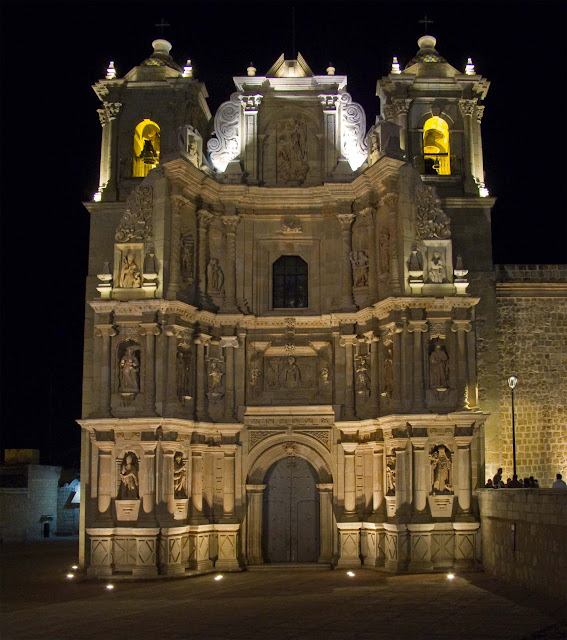
The facade at night

This screen design consists of four levels and pediment. In the center of the first part of the facade is the entry flanked by two fluted columns and Doric capitals and in four arched niches are represented St. Peter, St. Paul, St. Augustine and Santa Rosa de Lima. In the second section of the front of the building, above the main entrance, there is a relief depicting the Virgin Mary, kneeling and weeping at the foot of the Santa Cruz, a human skull and small branches of shrubs, representing life after death with two little angels at the sides, the first of them reminiscent of Veronica, the mantle with Christ on the roster, another seems to allude to the Archangel Michael. In four arched niches and pedestals are Santa Ana, San Joaquin, San Juan Evangelista and Santa Lucia.  The third level has the door of the choir and on the sides, the Annunciation of the Virgin Mary, with the archangel Gabriel on one side and the Virgin kneeling on the other.  There are also two niches with shell elements containing sculptures of San Sebastian and Santa Isabel and on the sides, two small reliefs representing St. Nicholas Tolentino and St. Nicholas Bari.  In the last level there is a relief alluding to the Assumption of the Virgin.


Mary kneeling and weeping at the foot of the Santa Cruz


The interior of the temple has an image of the Virgin of the Soledad, which is recognized as the spiritual patron of the people of Oaxaca and for whom is paid devotion similar to which nationally is given to the Virgin of Guadalupe.  Inside also are samples of the European Baroque painting at the time, the ecstasy of St. Augustine, Maria Magdalena, Santa Teresa, Santa Catalina Martyr, St. Jerome and St. Ursula.


The courtyard has two doorways, one south and one east, which connects to the garden Socrates.  To be continued….

Although it's necessary to cut down the resolution of pictures to conserve web album space the pictures on my web album have more resolution than these when you use the magnify glass ikon. 


Saturday, January 21, 2012

Mercado El Pochote


Over eight years ago with the help of the artist Francisco Toledo the organic market El Pochote opened on November 11, 2003. Originally located behind the colonial aqueduct in a beautiful tree shaded courtyard at García Vigil 817, but in July 2009 things changed with the market dividing into a daily market at Rayon 411, Xicoténcatl,  and a another at the the park of Santo Tomás, Xochimilco, open Fridays and Saturdays from about 10 in the morning through early afternoon.  The pictures here come from the original location and the current market in Xochimilco.


The market in Xochimilco usually has about 20 vendors selling fresh fruit and vegetables, coffee, mescal, pottery, weaving and embroidery, and prepared foods that range from tacos and memelas, to café, to Italian baked goods, to tejate, to Korean salads and Indian samosas, and back to tamales.  Although the market is small there a range of products which are difficult to find anywhere else.  While most vendors appear on a regular basis, offerings vary. 


The market in Xochimilco has become a gathering spot where friends meet for conversation and a bite to eat. A number of tables are set out under the shade of trees for people to gather so grab a chair, relax, and enjoy life. You can expect a bit of music to entertain you while you meet your friends.


For a closer look at the market at Rayon 411 please visit


Thursday, January 19, 2012

Jorge Wilmot


Jorge Wilmot, the most distinguished artisan ceramicist of Mexico, died January 12, 2012 in Tonala, México, at the age of 83. He has been credited with the introduction of stoneware and other high fire techniques to México.  His work is known internationally for its austere, Oriental-inspired designs blended with Mexican motifs. He influenced generations of ceramicists at the school he established in Tonalá, Jalisco.


Jorge began his own artistic studies at the Escuela de Artes Plásticas in the Academy of San Carlos before going on to Europe. There he studied at the Instituto Franco-Italiano in Paris, and worked in Sweden with ceramicist Limberg Koge Londgren.


Returning to México, he worked for the ceramics industry in Monterrey, making a number of innovations in technique and design. He eventually relocated to Tonalá, Jalisco, by the 1960s to establish his own workshop.  When he arrived to Tonalá, he felt that many Mexican ceramics were stuck in the past with no clear direction on how to adapt tradition to the modern world. He also felt that much of Mexico’s ceramic production had technically degraded. Using his international experience, he experimented with new ceramic forms, and new methods of firing, becoming one of the first artisan ceramicists to use gas ovens on a large scale. This facilitated his introduction of stoneware techniques and the recreation of the native “bruñido” pottery but fired at high temperatures.  During this time he held annual exhibits of his works at the Inés Amor Gallery bringing him much attention.

Wilmot also influenced Mexican ceramics by the blending of traditional Mexican designs and motifs with international and modern influences. Wilmot combined pre-Hispanic designs and motifs with modern elements as well as international influences, especially those from Asia.  Wilmot integrated Chinese crackled glazing (Jung Yao and Ko Yao) into a number of his pieces along with “celadon” and pale blue hues. His designs show a more austere Oriental influence rather than the common Mexican tradition of adding Baroque elements.

He was quoted as saying “La cerámica de las artes es una de las más antiguas y a su vez de las más modernas” (Ceramics is one of the oldest and most modern art forms.) He recognized to the need to preserve tradition and modify it.


The photos came from a retrospective of Jorge Wilmot at CASA in San Agustín Etla in January of 2010.  

Monday, January 16, 2012

Galería Quetzalli

In 1986 Graciela Cervantes and Claudina López founded Galería Quetzalli.  For the past twenty-five years has promoted the most recognized artists of Oaxaca such as Francisco Toledo, Alejandro Santiago, Maximino Javier, and José Villalobos, and a select group of international artists.  They now have two spaces, the Galería Quetzalli at Constitución 104-1 and the Bodega Quetzalli at Murgía 400. Their website is http://galeriaquetzalli.com.


The bodega currently has an exhibition Jardin Etnobotanico de Oaxaca by Patrick Pettersson.  He was a guest artist in the resident artist program at La Curtiduría in July and August of 2008. The work, oil and engraving on wood, is from the residency.  You can see the engraving below in the lines on the leaves and flowers.  His website is http://www.patrickpettersson.info/.


Last year the galeria presented work by Trine Ellitsgaard.  She was born in Denmark and trained as a weaver there but now lives in Oaxaca.  Her work in textiles uses different materials such as paper, gold thread, horsehair and copper and other materials. "My life in Oaxaca" is a piece in which Ellitsgaard combines silk with plastic, in this there are many knots, the creator said that "life here is complicated, so the knots, if I pay the phone it is very complicated, everything is a knot that you have to open." Below the textile has been woven with silk and the supplementary weft is plastic.