Showing posts with label art. Show all posts

Saturday, December 29, 2012

El sueño de Elpis


La siguiente descripción es de un blog relacionado con el proyecto de arte, www.elpisblog.org.

Proyecto artístico de Mauricio Cervantes , que involucra a artistas visuales, músicos, compositores y varios agentes de la sociedad que no necesariamente pertenecen al mundo del arte: permacultores, campesinos, jardineros, parteras, sanadoras, maestros de escuelas rurales.


La culminación será la ocupación—textualmente— de MATRIA, una casa en ruinas ubicada en la calle de Murguía 103, en el Centro Histórico de Oaxaca.


La ocupación de MATRIA con las intervencions artísticas será la culminación de una serie de acciones poéticas que se han efectuado en varios momentos del calendario estacional desde 2011.


Se ocupará la casa con esculturas, intervenciones lumínicas con neones e instalaciones sonoras por un espacio de ocho semanas, a partir del 1 0 de noviembre de 2012.

MATRIA servirá como espacio escénico para la presentación de conciertos y proyecciones cinematográficas.


De este modo MATRIA se convertirá en el espacio donde convivirán actores presenciales con presencias espectrales.

Tengo más fotos en mi álbum web de Picasa.
Para más información sobre el concepto del proyecto le animo a leer aquí.


The following description is from a blog connected with the art project, www.elpisblog.org.  The blog is in Spanish and contains links to other organizations involved in the work.  Google will give you an adequate but not elegant translation.  You may need to cut and paste the link into your search engine in order to activate translation.


El sueño de Elpis is an art project by Mauricio Cervantes , involving visual artists, musicians, composers and various actors in society that do not necessarily belong to the art world: permaculture, farmers, gardeners, midwives, healers, teachers in rural schools.


The culmination will be the occupation of Matria, a dilapidated house located at 103 Murguía Street, in the historic center of Oaxaca.  The occupation of Matria with artistic interventions will culminate with of a series of poetic actions.  It will occupy the house with sculptures, interventions with neon lighting and sound installations for a period of eight weeks from November 1st, 2012.  Matria will serve as performance space for the presentation of concerts and film screenings.


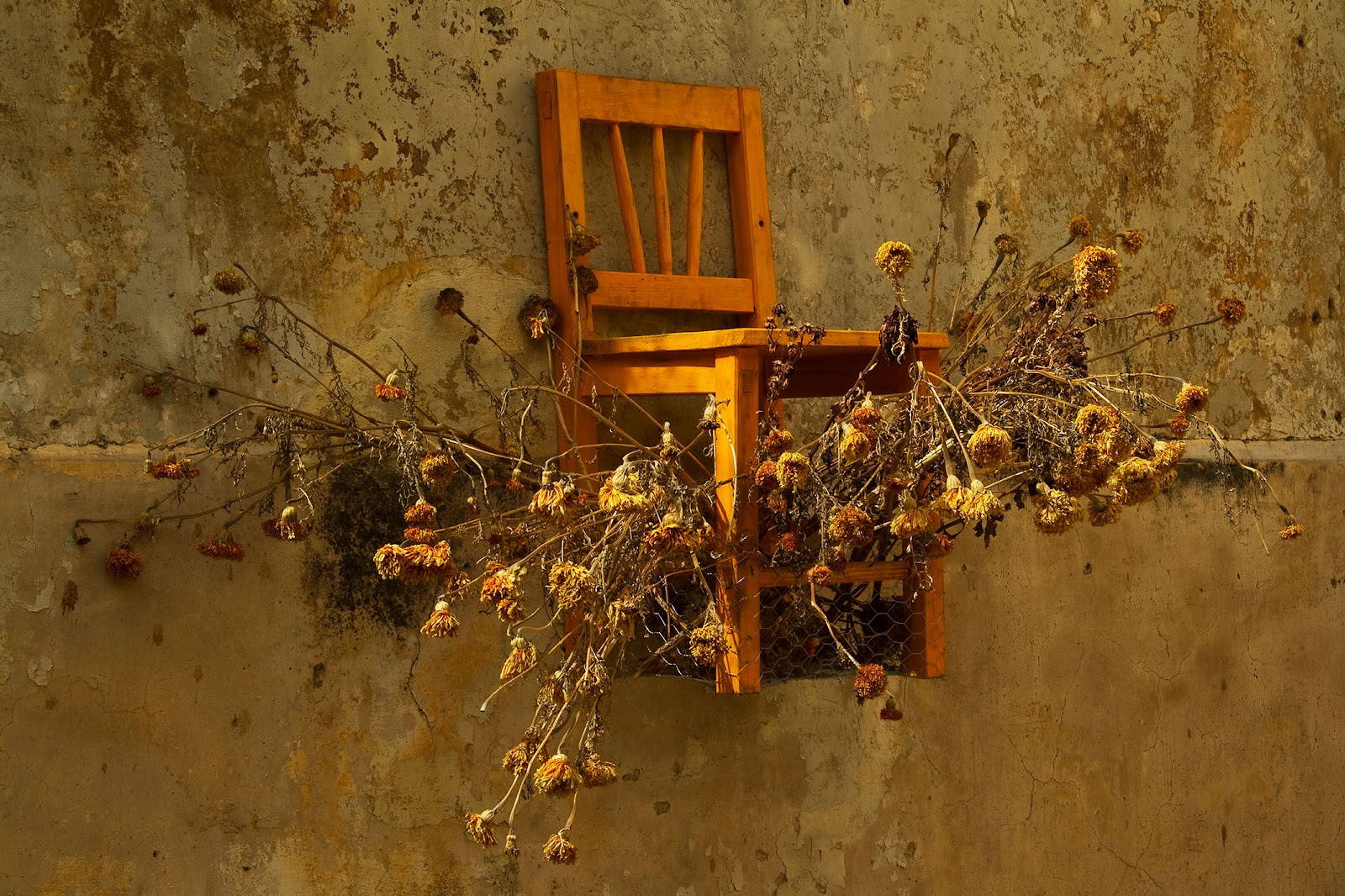
Art, as a reason for the project becomes a hinge on a meeting point in a thread, in a social pollinator, in the scenario that brings together the voices of a community. Beds and flowers, marigolds, are the main elements of the sculptures and installations placed in every corner of the house. The bed is the place where dreams are distilled, and where lovers lie.  It's design provides for the enjoyment of the lovers.


I have more photos on my Picasa web album.
For more on the concept of the project I encourage you to read here.


At sunset the light starts to come alive and gets augmented with fluorescent lights and sounds.


Thursday, January 19, 2012

Jorge Wilmot


Jorge Wilmot, the most distinguished artisan ceramicist of Mexico, died January 12, 2012 in Tonala, México, at the age of 83. He has been credited with the introduction of stoneware and other high fire techniques to México.  His work is known internationally for its austere, Oriental-inspired designs blended with Mexican motifs. He influenced generations of ceramicists at the school he established in Tonalá, Jalisco.


Jorge began his own artistic studies at the Escuela de Artes Plásticas in the Academy of San Carlos before going on to Europe. There he studied at the Instituto Franco-Italiano in Paris, and worked in Sweden with ceramicist Limberg Koge Londgren.


Returning to México, he worked for the ceramics industry in Monterrey, making a number of innovations in technique and design. He eventually relocated to Tonalá, Jalisco, by the 1960s to establish his own workshop.  When he arrived to Tonalá, he felt that many Mexican ceramics were stuck in the past with no clear direction on how to adapt tradition to the modern world. He also felt that much of Mexico’s ceramic production had technically degraded. Using his international experience, he experimented with new ceramic forms, and new methods of firing, becoming one of the first artisan ceramicists to use gas ovens on a large scale. This facilitated his introduction of stoneware techniques and the recreation of the native “bruñido” pottery but fired at high temperatures.  During this time he held annual exhibits of his works at the Inés Amor Gallery bringing him much attention.

Wilmot also influenced Mexican ceramics by the blending of traditional Mexican designs and motifs with international and modern influences. Wilmot combined pre-Hispanic designs and motifs with modern elements as well as international influences, especially those from Asia.  Wilmot integrated Chinese crackled glazing (Jung Yao and Ko Yao) into a number of his pieces along with “celadon” and pale blue hues. His designs show a more austere Oriental influence rather than the common Mexican tradition of adding Baroque elements.

He was quoted as saying “La cerámica de las artes es una de las más antiguas y a su vez de las más modernas” (Ceramics is one of the oldest and most modern art forms.) He recognized to the need to preserve tradition and modify it.


The photos came from a retrospective of Jorge Wilmot at CASA in San Agustín Etla in January of 2010.  

Wednesday, February 2, 2011

Full Mental Jacket


So what can one do in Oaxaca after the sun goes down? If you’re only here for a week or so then hanging out in the Zocalo, walking up and down the Acala, Oaxaca’s main pedestrian through fare, hanging out on a rooftop bar with a view, or listening to a bit of street music may be enough. Stay for a winter and you’ll need more diversions. Oaxaca has several opportunities for movies. There is an art theatre series at the Pocholte cinema, for folks in Seattle think of the Grand Illusion with a Mexican slant. They show a different film every night, mostly in Spanish but they had a Japanese series one month, Japanese with Spanish subtitles, whew. If you watch the various calendars around town other opportunities pop up from time to time. There was a recent showing of the John Lennon biopic ‘Imagine’ at the BS Biblioteca Infantil (children’s library – picture below), in English with Spanish subtitles, much easier. Movies pop up at all sorts of unlikely places like the Andy Goldsworthy flick, ‘Rivers and Tides’ last year at the Museo de la Filatelia (Stamp Museum – picture right). If you don’t know Andy Goldsworthy you should do your homework. A movie is a better way to experience his work than an art book of his naturalistic sculpture. There is an English Language Library in town that occasionally shows films, they also rent videos. Just keep your eyes and ears open. Oh if you want Hollywood there’s a multiplex at a shopping center a bit south of the central historic district. Lots of current shoot ‘um ups in both English and Spanish only a short taxi ride away.


Going to gallery openings is another diversion. Hardly a week goes by without an opening of something somewhere. Sometimes you can combine movies and galleries like at a recent screening of Pink Floyd Live at Pompei. OK the movie sucks but you used to enjoy the music in altered states and it still holds up today with the help of a little mescal. Maybe that’s why the English dialog with English subtitles seemed confusing. The price was right, gratis. The screening was at the Museo Casa de la Ciudad but the movie was put on by Biblioteca Andres Henestrosa which is housed in the museum space so the announcements referred to the library which was a bit confusing as well. A week or two earlier the art exhibit ‘Full Mental Jacket’ by David Velasco Sosa opened in the same spot. You were expecting mention of yet another old flick? Well that was ‘Full Metal Jacket’. From the opening announcement, here is a rough translation, “These days, graphic design has operated on two fronts very different from each other. The first is utilitarian reducing the image to the sale of goods and services. The other is more elusive, it explores media formats and distances itself from the principle of applied arts, namely to build and pass on certain information that has a specific function. The pieces presented by David Velasco at this exhibition feature graphics from the first sense to which he has added the a destabilizing nonsense and a clumsiness of parody which fulfill the "Freudian slip" of the "b-movies making clear what is hidden in the slickness of the classic sales pitch.” (That’s sort of rough and greatly cut down, just be glad you didn’t get the Google Translate version and btw Microsoft Word can’t spell Google.) Somehow the two fit together but Velasco had nothing to say about Pink Floyd. Pictures from the exhibit can be found here. Be warned while some images are simply graphic design and others playful and fun, there are others that bite rather hard.