 |
| La Basílica de Nuestra Señora de la Soledad from the Plaza de la Danza |
The first temple dedicated to the Virgen de la Soledad in Oaxaca
City was built in the early years after the Conquest of Mexico. When in 1532
King Charles I of Spain granted the city title to the Antequera de Oaxaca,
There rose in the vicinity of Fort Hill a small shrine dedicated to St.
Sebastian. The temple included a small chapel dedicated to the Virgin of La
Soledad.

 |
| A plaque commemorating the story of La Soledad next to statues depicting the story |
The event that gave rise to the present shrine dates back to
1617 when, according to tradition, a muleteer from Veracruz bound for Guatemala
noticed - upon arrive at Oaxaca - in his
herd had one
more mule. Passing by the
hermitage of San Sebastián, the mule fell down overcome by the load he was
carrying. The attempt of the carrier to lift it was useless and told the authorities to
avoid punishment. When removing the burden of the mule, it died instantly. The cargo was checked and they found the
image of the Virgin, accompanied by a Christ and a sign saying The Virgin at the
foot of the Cross. Faced with this event, the bishop ordered Bohórquez Bartholomew to build a shrine in honor
of the deity on the site. The feast
day for La Soledad is December 18th but the festivities last more
than a week.
 |
| The plaza de la Danza filled with food comedores during the fiesta for La Soledad |
The current Basilica of Our Lady of Solitude was built between
1682 and 1690, and is a shrine to the Virgin de la Soledad, the patron saint of
the city of Oaxaca. The present
facade was built between 1717 and 1718.
The temple is one of the most outstanding examples of religious
architecture from the colonial era of Oaxaca, especially the main entrance,
which is of the seventeenth century Baroque style. The cover is unique and
characterized by the form of a screen that makes it look like a huge buttress.
The Basilica de la Soledad has a Latin cross plan and has a
seismic design, because by the time construction began, several buildings had
been ruined in Oaxaca during earthquakes suffered by the city. Two
barrel-vaults cover the building. At their junction is a dome octagonal, whose
outer surface is covered with tiles. The essential material of the building is
the green stone, a stone very common in parts of Oaxaca. In contrast, the
magnificent artwork was done in yellow quarry, and is slightly out of the temple
toward the atrium compared with steeples.
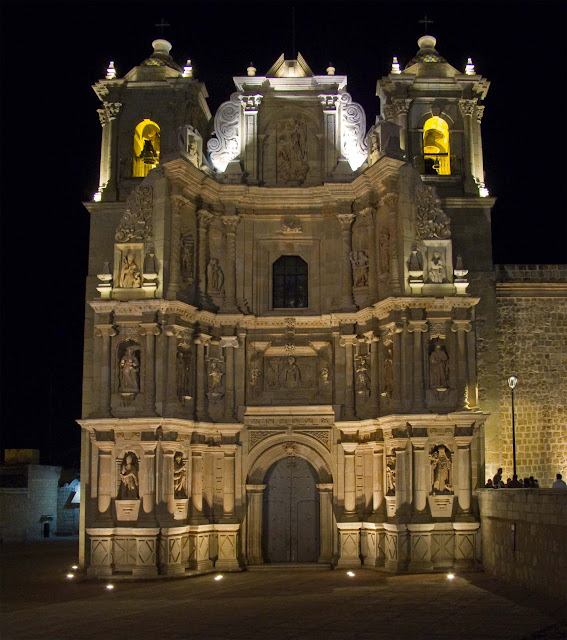 |
| The facade at night |
This screen design consists of four
levels and pediment. In the center of the first part of the facade is the entry
flanked by two fluted columns and Doric capitals and in four arched niches are
represented St. Peter, St. Paul, St. Augustine and Santa Rosa de Lima. In the
second section of the front of the building, above the main entrance, there is
a relief depicting the Virgin Mary, kneeling and weeping at the foot of the
Santa Cruz, a human skull and small branches of shrubs, representing life after
death with two little angels at the sides, the first of them reminiscent of
Veronica, the mantle with Christ on the roster, another seems to allude to the
Archangel Michael. In four arched niches and pedestals are Santa Ana, San
Joaquin, San Juan Evangelista and Santa Lucia. The third level has the door of the choir and on the sides,
the Annunciation of the Virgin Mary, with the archangel Gabriel on one side and
the Virgin kneeling on the other.
There are also two niches with shell elements containing sculptures of
San Sebastian and Santa Isabel and on the sides, two small reliefs representing
St. Nicholas Tolentino and St. Nicholas Bari. In the last level there is a relief alluding to the
Assumption of the Virgin.

 |
| Mary kneeling and weeping at the foot of the Santa Cruz |
The interior of the temple has an image of the Virgin of the
Soledad, which is recognized as the spiritual patron of the people of Oaxaca
and for whom is paid devotion similar to which nationally is given to the
Virgin of Guadalupe. Inside also
are samples of the European Baroque painting at the time, the ecstasy of St.
Augustine, Maria Magdalena, Santa Teresa, Santa Catalina Martyr, St. Jerome and
St. Ursula.

The courtyard has two doorways, one south and one east, which
connects to the garden Socrates.
To be continued….
Although it's necessary to cut down the resolution of pictures to conserve web album space the pictures on my web album have more resolution than these when you use the magnify glass ikon.


