Saturday, December 15, 2012

El Baile


El baile “Flor de Piña”

During the month of December, often there are performances by school and university groups on stages in the Zocalo or on Cinco de Mayo and Constitución where these performances took place last week.  The first four pictures are of the dance "Flor de Pina", the dance that represents the region of San Juan Bautista Tuxtepec in the celebrations of the Guelaguetza.  Particularly noteworthy is the age of the band which you can see in the 4th from the last picture.  They appear to be middle school age.  Due to the strong frontal stage lights and only having a pocket camera at the time I have turned them into faux paintings.  A few are in larger format.  If you like you can visit my Picasa Web Album where you can use the magnifying glass icon to enlarge them or view them as a slideshow.

El baile “Flor de Piña”

El baile “Flor de Piña”

El baile “Flor de Piña”


Hiking in Oaxaca

During the winter there is a weekly hiking group that goes somewhere every Friday.  It just happens that next week, December 21st. they are going to hike along the aqueduct that winds up into the hills above San Agustin Elta.  The group is informally led by Larry  Ginzkey. He has set up a website http://www.hoofingitinoaxaca.com/ where you can get more information or sign up for a hike, or you may contact him by email if you are interested ginznoaxaca@aol.com.  The pictures are from the hike last year.

Larry is on the left


Monday, December 10, 2012

Zanqueros


Transcomunalidad Intervenciones Y Colaboraciones Con Comunidades De Zanqueros

El 7 de diciembre, el museo textil tuvo una inauguración de la Transcomunalidad Intervenciones Y Colaboraciones Con Comunidades de Zanqueros. Como una parte de la inauguración hubo una actuación de zanqueros de Oaxaca, Mx y Brooklyn, NY. En el museo se pueden ver los trajes de muy buena calidad y una colección de muñecas vestidas como zanqueros. La exposición continúa hasta el 12 de abril.

Esta descripción es de folleto de la exposición del Museo Textil:

La presente exposición es una muestra del trabajo realizado por Laura Anderson Barata, artista multidisciplinar, en conjunto con zanqueros tradicionales de las Antillas y México.  En colaboración con Miembros de la comunidad y artesanos tradicionales, Laura fusiona dinámicas del arte contemporáneo y participativas. Cada una de las piezas que se presentan en esta muestra han formado parte de una celebración, de una ceremonia, o bien, de intervenciones espontáneas, como en el Carnaval de Puerto Espana, El Desfile de las Antillas de Brooklyn, el Museo de Arte Moderno de Nueva York, las calles de Wall Street en Nueva York, y los Festejos de San Pedro y San Pablo en Zaachila, Oaxaca.  En las obras resultantes confluyen las nociones de arte comunitario, arte público, performance, escultura y tradición.

Transcomunalidad presenta el inicio de este proyecto en Trinidad y Tobago y la integracion que ha hecho Laura con un grupo de zanqueros de las Indias occidentales y África Occidentale que actualmente vive en Brooklyn: The Brooklyn Jumbies. Más recientemente se han incorporado Los zancudos de Zaachila, en Oaxaca.  La unión de estas tradiciones vivas en colaboración ha sido un ejercicio de acompañamiento: su propuesta ha creado puentes entre continentes, culturas y comunidades, donde los trajes resultantes demuestran la fusión del arte contemporáneo con aspectos tangibles e intangibles del patrimonio cultural.

Hay muchas más fotos si usted va a mi álbum web de Picasa haciendo clic aquí.


On the 7th of December the textile museum had an inauguration of the Transcomunalidad Intervenciones Y Colaboraciones Con Comunidades De Zanqueros.  As a part of the inauguration there was a performance by stilt walkers from Oaxaca, Mx and Brooklyn, NY.  In the museum you can see costumes of very fine quality and a collection of dolls dressed as stilt walkers.  The exhibition continues until the 12th of April.

This exhibition is the work of Laura Anderson Barata, multidisciplinary artist, along with traditional stilt walkers of the Antilles and Mexico. In collaboration with community members and traditional craftsmen, Laura merges the dynamics of contemporary art and participation. Each of the pieces presented in this exhibition have been part of a celebration, a ceremony, or spontaneous intervention, as in the Carnival of the Port of Spain, the West Indian Parade in Brooklyn, the Museum of Modern Art New York, the streets of Wall Street in New York, and San Pedro and San Pablo Celebrations in Zaachila, Oaxaca. The resulting works bring together the notions of community art, public art, performance, sculpture and tradition.

Transcomunalidad presents the beginning of this project in Trinidad and Tobago and the integration that Laura made with a group of West Indian and Western Africa stilt walkers now living in Brooklyn: The Brooklyn Jumbies, and more recently having incorporated Los Zancudos de Zaachila in Oaxaca. That the union of these traditions live in collaboration has been an exercise in accompaniment; the proposal has created bridges between continents, cultures and communities, where the resulting fusion of costumes show contemporary art with tangible and intangible aspects of cultural heritage.

There are many more photos if you go to my Picasa Web Album by clicking here.

Friday, September 14, 2012

Nuevo diseno textil 2011 (en español y en inglés)


Para citar a Alejandro de Ávila B., curador del exposiciones en el Museo Textil de Oaxaca.


Zenaida Pérez Mendoza es una tejedora magistral de Pinotepa de Don Luis, en la costa de Oaxaca.  Zenaida habla tu un savi que podemos traducir como palabra de la lluvia sagrada.  En español designamos a su lengua y a su pueblo como mixtecos, termino derivado del náhuatl mixtecah, gente de los nubes. El año pasado de 2010, Zenaida tejió tres lienzos para un huipil que le encargó Remigio Mestas Revilla, apasionada promotor del arte textil de Oaxaca.  Zenaida tejió esta vez el tipo más fino de huipil, usado antiguamente por una mujer el día que se casaba y guardado por ella con cuidado toda su vida para ser enterrada en él cuando moría. Olga González Pérez, hija de Zenaida, ha seguido los pasos de su madre. Ahora teje lienzos aun más delicados, casi transparentes, donde los diseños, blancos parecen flotar en el aire.  No es probable que Olga vista un huipil para su boda porque, a diferencia de su madre, ella no usa el posahuanque, la falda de enredo de las mujeres mixtecas de la costa. Huipil y posahuanque  son íconos de la identidad indígena, y la juventud de Don Luis ya no quiere ser discriminada por su herencia cultural. Pero de manera paralela y contradictoria, la habilidad de Olga y de Zenaida como tejedoras se ha refinada conforme sus lienzos son reconocidos en el ámbito urbano como arte a secas, sin el calificativo "popular".  Nos parece poéticamente justo que la gente de las nubes siga distinguiendose por obras tan etéreas.


Esta exposición muestra el trabajo de Olga y otras artistas destacadas del telar y la aguja hoy día. Se trata en todos los casos de piezas especiales, hechas por encargo para ser vendidas y admiradas fuera de su comunidad de origen.  Los lienzos tejidos en Don Luis ejemplifican esta tendencia innovadora: Remigio le proporcionó a Olga hilo de algodón egipcio para las diseños brocados. Varias otras piezas aquí expuestas fueron hechas de igual manera con hilaturas industriales de alta calidad, que no se consiguen en el mercado nacional.  Muchas de los tejidos que presentamos combinan esos materiales importados con hilados manuales de seda y algodón teñidos con los colorantes más apreciados de Oaxaca y de México: la grana del nopal, el caracol púrpura y el añil vegetal. Si bien los tintes por sí mismos nos remiten al pasado mesoamericano, las tonalidades puras logradas para esta muestra son sutilmente distintas de las piezas antiguas. Más aun, las combinaciones cromáticas son en muchas casos radicalmente diferentes de los huipiles y enredos que vistieron las abuelas de estas artistas, pero manifiestan un sentido del color tan rico y consumado como los mejores tejidos clásicos de Oaxaca.


Podemos apreciar ese mismo patrón de innovaciones harmoniosas si examinamos el diseño de las piezas expuestas. Olga y sus companeras de generación han retomado las figuras tradicionales, recreandolas con ajustes de escala y densidad para lograr composiciones novedosas. En algunos casos han ideado una iconografía enteramente distinta, que sin romper con los cánones formales del diseño indígena, como la simetría bilateral y bifacial del las prendas,plasma nuevas ritmos visuales. Abren de esa manera nuestra percepción a un impulso creativo que rebasa las expectativas del arte popular mexicano convencional. De repente advertimos en algunas piezas semejanzas con ciertos textiles africanos, mientras que otras nos evocan el art deco o la gráfica op-art de los años 1960. Esas impresiones, sin embargo, son engañosas. No estamos asistiendo a una hibridación plástica transcultural, ni mucho  menos. Las tejedoras y bordadoras simplemente han iniciado nuevas exploraciones dentro de las posibilidades que les ofrecen los materiales, las técnicas y los formatos tradicionales. Si la muestra nos sorprende es por la creatividad liberada cuando las artistas comunitarias son motivadas y retribuidas de manera digna.

Para ver más fotos por favor vaya a mi álbum web de Picasa.


To quote Alejandro de Ávila B., curator of exhibits at the Museo Textil de Oaxaca.

Zenaida Perez Mendoza is a master weaver of Pinotepa de Don Luis, on the coast of Oaxaca. In Spanish we designate her language and her people as Mixtec, a term derived from Nahuatl mixtecah, people of the clouds. Last year, 2010, Zenaida wove three linen cloths for a blouse that was ordered by Remigio Mestas Revilla, passionate promoter of Oaxaca textile art. This time, Zenaida wove the finest type of huipil, used by a woman on her wedding day and carefully saved by her all her life in order to be buried in it when she died. Olga Gonzalez Perez, Zenaida’s daughter, has followed in the footsteps of her mother. Now even more delicate woven linen, almost transparent, where white designs seem to float in the air. Olga is not likely to wear a blouse for her wedding because, unlike her mother, she does not use the posahuanque, the gathered skirt of Mixtec women from the coast.  Huipil and posahuanque are icons of indigenous identity, and the youth of Don Luis do not want to be discriminated by their cultural heritage. But in parallel and contradictory, the ability of Olga and of Zenaida, how weavers have refined in accordance with their linens as his paintings are recognized in urban areas as art itself, without the adjective "popular".  It seems poetic that people who follow the clouds are distinguished by works so ethereal.

This exhibition showcases the work of Olga and other outstanding artists of the loom and needle today. These are all special pieces, made ​​to order, to be sold and admired outside their home community. The linen fabrics in Don Luis exemplify this innovative trend: Remigio provided Olga with Egyptian cotton thread for brocaded designs. Several other pieces presented here were done the same way with high quality industrial yarns, which are not available in the domestic market. Many of the fabrics we present combine these materials imported handspun silk and cotton yarn dyed colors most cherished of Oaxaca and Mexico: cochineal, purple from snails and the indigo plant. While the dyes themselves remind us of the Mesoamerican past, pure hues achieved for this sample are subtly different from the old pieces. Moreover, the color combinations are in many cases radically different from the huipiles and posahuanque that the grandmothers of these artists wore, but they express a sense of color so rich and accomplished as the best classic fabrics Oaxaca.


We see the same pattern of harmonious innovations by examining the design of the exhibits. Olga and her co-generation have taken up the traditional figures, recreating them with adjustments of scale and density to achieve novel compositions. In some cases they have devised an entirely different iconography, without formal breaking with the canons of indigenous design, as reciprocal and two sided symmetry of the garments, new visually flowing rhythms. In that way they open our perception to a creative impulse that exceeds the expectations of conventional Mexican folk art. Suddenly we notice some similarities with certain parts African textiles, while others evoke the art deco or graphic op-art of the 1960s. These impressions, however, are misleading. We are not witnessing a plastic cross hybridization, far from it. The weavers and embroiderers simply have initiated new exploration into the possibilities offered materials, techniques and traditional formats. If the sample is surprises us, it is for creativity released when the community artists are motivated and rewarded in a dignified manner.

For more pictures please go to my picasa web album.


Friday, September 7, 2012

Threads of the cloud people, communal textiles from Oaxaca


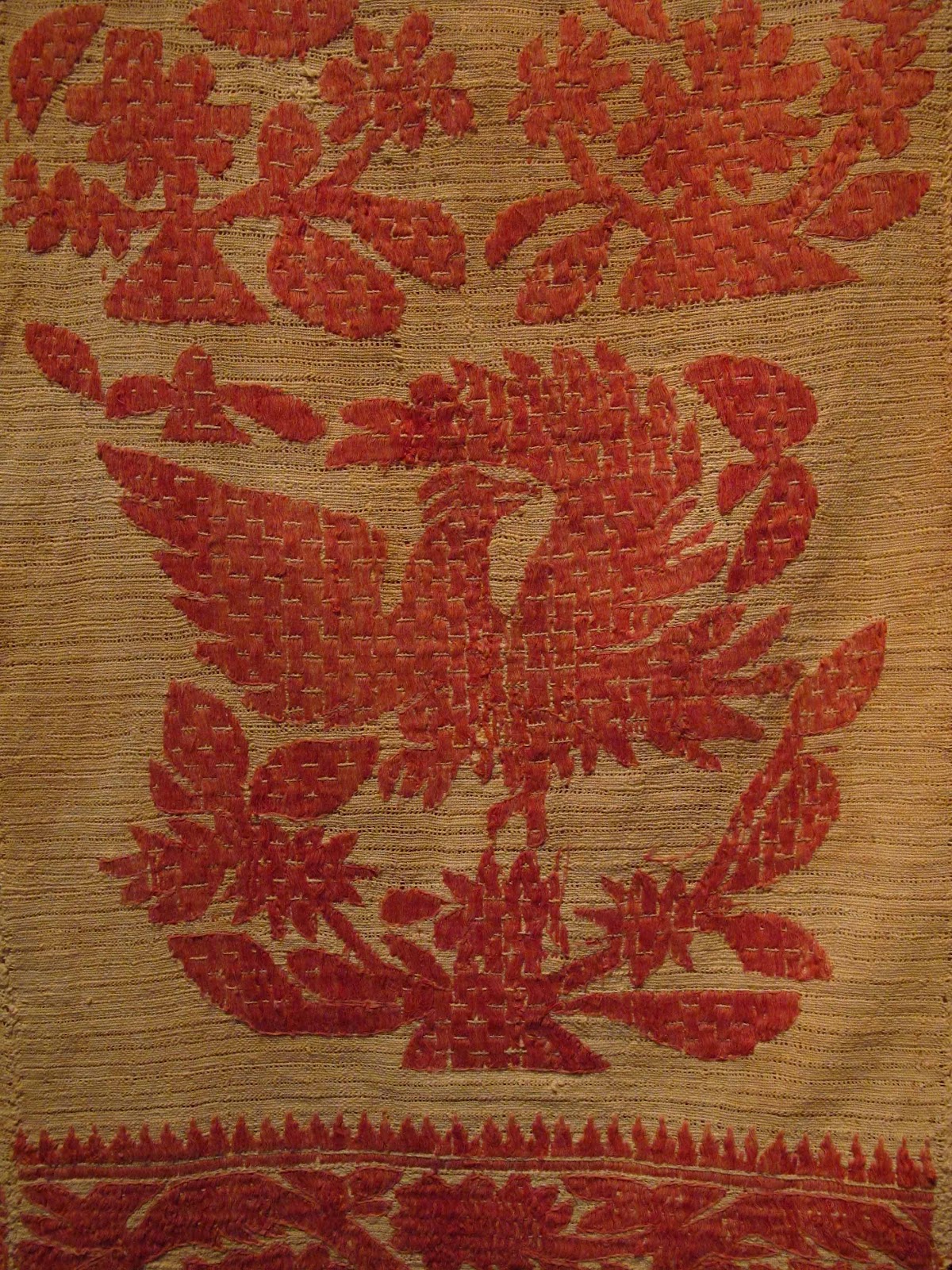
In December of 2012 the Museo Textil de Oaxaca hosted two important exhibitions.  One traditional, called Threads of the cloud people, consisted of textiles from all over the state of Oaxaca dating from the late 19th century to the present; the other consisted of commissioned work called Nuevo diseño textil 2011.  You might think of the second as an extension of the first.  This post will include photos from Threads of the cloud people.  For more photos and a chance to enlarge them to the size of the opening photo, please check out my Picasa photo album.  A following post will cover Nuevo diseño textil 2011.  In the words of Alejandro de Ávila B., curator:

Threads of the cloud people, communal textiles from Oaxaca

The diversity of their materials, styles and designs brings Oaxacan textiles to the forefront among the visual arts of the Americas. In this mountainous, ecologically complex region, where the main ethnic groups call themselves the "cloud people" and "sacred rain's collectivity," many kinds of plants, animals and minerals have been used to obtain fibers and dyestuffs, probably in greater variety than in other areas on this continent. In tandem, woven structures appear to have become more diversified in Oaxaca than in other regions of Mexico and Central America. Many of those fibers, colorants and techniques ceased to be used in the last fifty years. Lost along with them were fine manual skills and a wide repertoire of designs.  The majority of the weavings and embroideries were not produced for commercial purposes, but to be used by the people who made them in the indigenous communities, as well as in Afro-Mexican and Mestizo towns. Intended for the domestic and ritual life of groups who are culturally distinct, huipiles and other garments preserved iconographic and stylistic traits that evoke different historic periods. Maintained alive with those traits was a tradition of narrative that recreates, in some cases, the meaning of the woven figures.

We have selected for this exhibit some outstanding pieces in the collection of the Museo Textil de Oaxaca to illustrate the variety of materials and designs in textiles that were manufactured for peoples' own use in different areas of the state. As we present everyday and ceremonial garments that date from the late 19th to the 21st centuries, we aim to put into perspective a rapid evolution of attire, what we could call the communal fashions of Oaxaca of the last one hundred years. We do not show here weavings or embroideries made for the outside market once tourism took hold; we exclude commercial pieces in order to highlight the sheer diversity and the aesthetic refinement of textiles created by exceptionally talented individuals to dress themselves and their families. In choosing the pieces for the show, we have tried to cover evenly the different ethnic groups in the state, including people of African and European cultural ancestry.

The exhibit is organized in four chronological sections. The first shows the earliest pieces in our holdings, woven during the second half of the 19th century and the early 1900s.  Salient among them is an exceptional rebozo, the only silk weaving that has been preserved from Coyotepec, dyed with the most important dyestuffs in Mesoamerica: cochineal, indigo and shellfish purple. The second section of the show includes pieces that were made in the early decades of the 20th century, when worsted yarn and other industrial manufactures became widespread in southern Mexico.  A beautiful wraparound skirt from Tututepec illustrates the early adoption of machine-spun threads and synthetic dyes, combined with traditional materials.  The third section features weavings and embroideries made in the mid-1900s, a period of drastic change in many communities. A huipil from Choapan, decorated with two techniques historically restricted to Oaxaca, bears witness to the loss of the textile arts in various areas of the state during that period. The fourth section is dedicated to the late 20th century and the most recent decade, which have seen the introduction of acrylic wool and other fibers derived from petroleum. A blouse from Santa Lucía Miahuitlán, embroidered in 2009, attests to the vitality of an elegant and delicate taste for textiles in some of the poorest communities of our country.  The most important exhibit mounted so far in this museum thus ends on a note of hope.

Alejandro de Ávila B.