Sunday, March 13, 2011

Yanhuitlán - Manuel Reyes


Santo Domingo Yanhuitlán es un pueblo de la Alta Mixteca del estado de Oaxaca, situado al noreste de la ciudad de Oaxaca. Su nombre proviene de la patrona de la ciudad (Santo Domingo) y la última parte es del náhuatl. El pueblo está dominado por el Templo y Ex-convento de Santo Domingo construido a partir de 1541. También es el hogar de ceramista Manuel Reyes. Primero visitamos Manuel Reyes quien nació en la Ciudad de México en diciembre de 1972 a los padres de Oaxaca.

Mis padres son de la Mixteca Alta, en esta región del estado, y siempre me he considerado un oaxaqueño. Esa es mi herencia, mi derecho de nacimiento. Aunque he tenido la formación de algunos de los grandes maestros del arte mexicano, he desarrollado una gran parte de mi estilo artístico de mirar y hablar con los artistas locales aquí en la Mixteca.


Santo Domingo Yanhuitlán is a village in the Mixteca alta of the state of Oaxaca, located northeast of Oaxaca city. Its name comes from the patron saint of the town (Saint Dominic) and the last part is from Náhuatl.  The village is dominated by the Templo y Ex-convento de Santo Domingo built in starting in 1541. It is also home to  ceramic artist Manuel Reyes. First we visit Manuel Reyes who was born in Mexico City in December 1972 to Oaxacan parents.

My parents are from the Mixteca alta, in this region of the state, and I've always considered myself a Oaxacan. That's my heritage, my birthright. While I've had training from some of the grand masters of Mexican art, I've developed a large part of my artistic style from watching and speaking to local artists right here in the Mixteca.


En 1990 Reyes comenzó a estudiar arte en la Escuela Nacional de Artes Plásticas en Xochimilco, Ciudad de México. En 2003, Reyes regresó a la Mixteca a restablecido en sus raíces.

" Las lecciones que aprendí a través de mi entrenamiento formal han sido inestimables, pero obtener inspiración y han adoptado técnicas no sólo de mis maestros, a quien le debo mucho, pero también de los artistas y artesanos del barrio oaxaqueño de Nochixtlán. " Reyes trabaja en conjunto con su esposa Maricela, un talentoso artista en su propio derecho. " Lo que he aprendido de la gente de mi cultura ha sido muy valiosa para mi trabajo, el uso de un horno de leña hecho de barro y ladrillo, sobre los diferentes tipos de arcillas para esculpir disponibles en Oaxaca y la forma de mezclar diferentes tipos de los suelos para crear una amplia gama de colores de la pintura y los tonos y texturas. Al final, mis piezas son producto de mi ambiente local. "


In 1990 Reyes began studying art at the Escuela Nacional de Artes Plásticas in Xochimilco, Mexico City. In 2003, Reyes returned to the Mixteca to re-established his roots.

"The lessons I learned through my formal training have been invaluable, but I gain inspiration and have adopted techniques not solely from my teachers, to whom I owe a great deal, but also from the artists and craftspeople of the Oaxacan district of Nochixtlán." Reyes works together with his wife Maricela, a gifted artist in her own right. “What I've learned from the people of my culture has been invaluable to my work, the use of a wood-burning kiln made of mud and brick, about the different kinds of clays for sculpting available in Oaxaca and how to mix different kinds of soils to create a broad range of paint colors and tones, and textures. In the end, my pieces are products of my local environment."


Reyes explica la imaginería sexual representa en sus esculturas actuales. "He estado haciendo un buen número de hombres desnudos desde el año 2005, no inicialmente por el diseño específico, sino más bien porque eso es lo que se representa a menudo en el arte y las representaciones de las actividades del día a día prehispánica, y ese es el tipo de trabajo que he disfrutado haciendo en los últimos tres años. Cuando nos fijamos en las primeras figuras de barro zapoteca, y de hecho los que datan de los olmecas y los primeros tiempos, eso es lo que mis antepasados ​​estaban creando. varias esculturas retratar la esperanza y la oración, así , por lo tanto una parte de la antigüedad, con la cabeza mirando hacia arriba a los cielos y las manos en alto. "  Reyes reconoce que esto sigue siendo un negocio por lo que cuando los coleccionistas de hombres gays comenzaron a tomar interés en esta fase de su desarrollo artístico, que lo motivó a continuar y experimentar con el tema de la sexualidad masculina, como se representa en los códices y esculturas de civilizaciones anteriores.

Reyes experimentos con máscaras como una forma de arte. Su uso en las fiestas es común en Oaxaca, la tradición que se remonta quizás 3.000 años.  Manuel también le gusta el rock y el blues de los años 60 y 70 así como un homenaje que ha creado figuras de John Lennon, Jimi Hendrix y Jim Morrison. Para ver Juan y Jimi y más de la obra de Manuel visitar mi álbum web.


Reyes explains the sexual imagery depicted in his current sculptures. "I've been doing a fair number with nude males since 2005, not initially by specific design, but rather because that's what is often depicted in pre-Hispanic art and representations of day-to-day activities, and that's the kind of work that I've enjoyed doing over the past three years. When you look at the earliest Zapotec clay figures, and in fact those dating to Olmec and earlier times, that's what my ancestors were creating. A number of sculptures portray hope and prayer as well, so much a part of ancient times, with head looking upward to the heavens and hands raised."

Reyes acknowledges that this is still a business so when gay male collectors began taking an interest in this phase of his artistic development, it motivated him to continue and experiment with the theme of male sexuality as depicted in the codices and sculptures of earlier civilizations. 
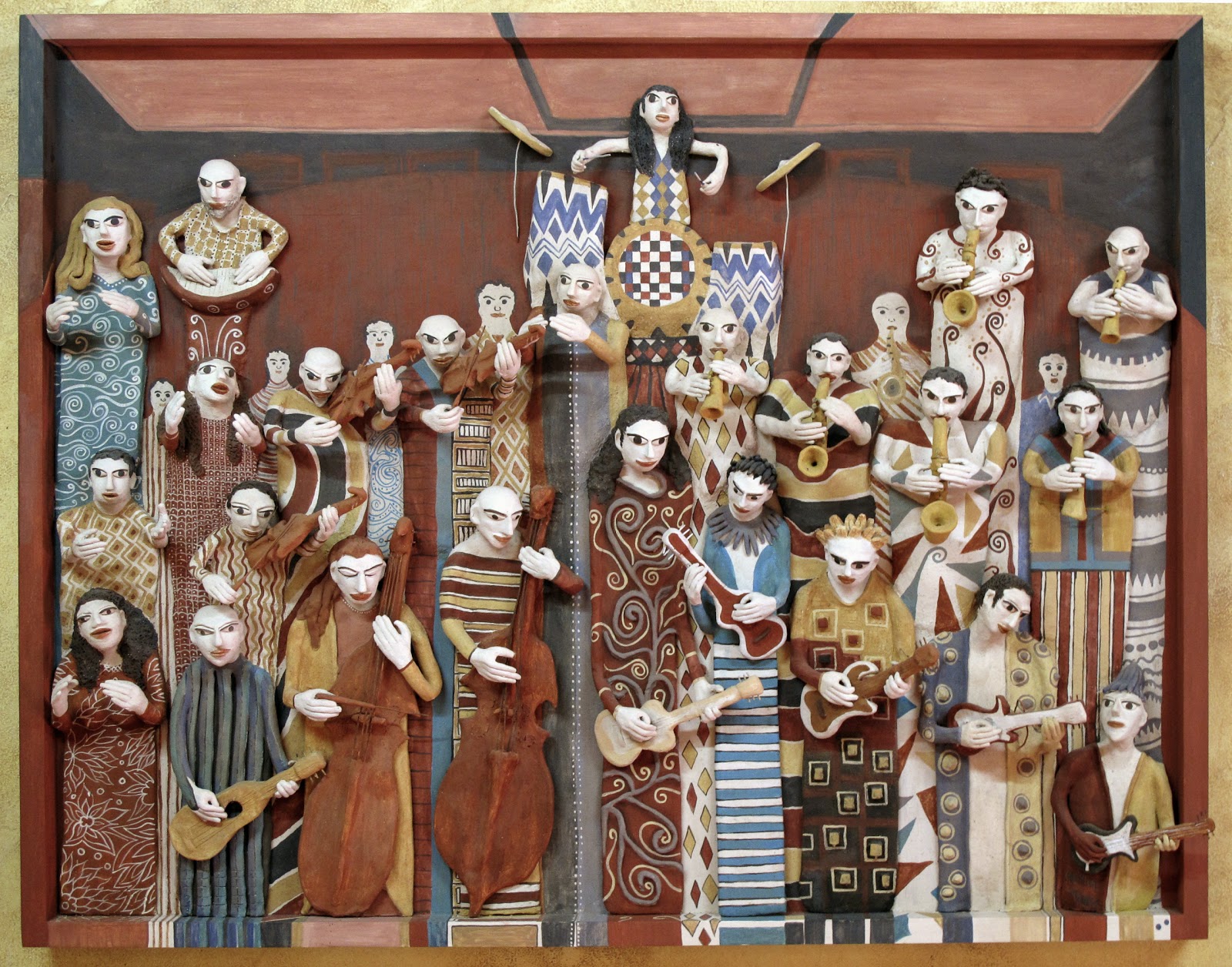

Reyes experiments with masks as an art form. Their use at fiestas is common in Oaxaca, the tradition dating back perhaps 3,000 years. Manuel also likes rock and blues of the '60s and '70s so as a homage he has created figures of John Lennon, Jimi Hendrix and Jim Morrison. To see John and Jimi and more of Manuel's work visit my web album.

Tuesday, March 8, 2011

Jazz in a Tropical Garden

Jane Robinson of Casa Colonial has put on Jazz in a Tropical Garden with Miguel Sampiero (right) and friends for roughly six years on the first Sunday of the month from 4 to 6 PM. The setting is lovely. They have a bar and comfy chairs on the lawn. The weather cooperates. The music is lovely and no telling who might show up to sit in. For more info on Casa Colonial check their website. For more pictures check my picasa web album.


Tuesday, March 1, 2011

Museo de los Pintores Oaxaqueños


The Museo de los Pintores Oaxaqueños hosts shows for emerging local artists. The building itself dates from 1695 and in 2004-5 under went restoration emerging as the art museum you can visit today. Located at the corner of Independencia and Garcia Vigil across from the Alameda de León and the Catedral de Oaxaca.

Desarrollo Luminoso by Rola Vallejo

Oaxaca has a long tradition in the arts from Monte Alban, continuing with Rufino Tamayo, and today has the artist Francisco Toledo as its most prominent representative. Since ancient times the people of the valleys of Oaxaca have been encountering the peoples of the Anahuac valley of central Mexico. Also stepping from the plateau to the isthmus they encountered the Mayan culture. There is evidence of this cultural wealth in Monte Alban and Mitla. This heritage, that the people of Oaxaca are innate artists, is evident in the Mixtec codices and murals Huijazó's Tomb. The sensitivity and creativity of the Oaxacan people is expressed in the highest aspiration of its painters. The painters are the eyes, hands and hearts of people. Their paintings leave evidence of the spiritual greatness and love for life, which for millennia has characterized the people of Oaxaca. From the ancestors who decorated the walls of the centers of knowledge in Mitla and Monte Alban, or the pictorial art in the Mixtec codices, to Miguel Cabrera, a painter of the colonial era, who left masterworks in many temples of New Spain. Now we must think about Rufino Tamayo, Rodolfo Nieto and Rodolfo Morales, as they have crossed the river on their long road to Mictlan (the underworld of Aztec mythology). Today, Francisco Toledo lives not only as a universal artist, but also as a generous patron who has given the pleiades of Oaxacan artists a cultural center, where altruism towards cultural and natural heritage is recognized. This altruism derives from Gozona, which is a word from the Zapotec that can be defined as similar to the Golden Rule. The Gozona means giving and receiving, and sharing with neighbors by paying homage to their deities as the saints are insatiable. In this art is part of the village ritual and beneficial to our imagination and our sensibilities, always tuned and alert. What is better than art and music to entertain the ceremonies? Through the mist of the mountain, the Copel, flowers, and dancing, the community reaches its exquisite fullness. The art of the party remains active with its vibrant colors, dances, ceremonies, fireworks, unusual costumes, and surprises found in the inexhaustible cascade of fruit, candy and objects found these days in public squares and markets. Oaxacan art is an expression from this feeling of community.


The Museum of Oaxacan Painters was created with the aim of providing an open space to development of contemporary visual and graphic arts in the state, offering exhibitions to promote and publicize the work of artists from Oaxaca.
Cortando Flor de Zempazuchitl, by Pedro Tapia.

Today these include Juan Alcazar, Laura Armenta, Roman Andrade, Fernando Andiacci, Modesto Bernardo, Marco Bustamante, Enrique Flores, Federico Flores, Justina Fuentes, Irma Guerrero, Sergio Hernandez, Maximo Javier, Yvonne Kennedy, Ruben Leyva, Abelardo López, Emiliano Lopez, Francisco Lopez, Gonzalo López, Luis José, Eddie Martinez, Ariel Mendoza, Arnulfo Mendoza, Felipe Morales, Guillermo Olguin Guillermo Pacheco, Tomás Pineda, Rolando Rojas, Samuel Rojas, Cecilio Sanchez, Jorge Sanchez, Emilio Sanchez, Virgilio Santaella, Alejandro Santiago, Santiago Filemeón, Crispin Valladares, Jose Villalobos, Emilia Winter and Luis Zarate.


The museum has three main objectives the promotion of the work of graphic artists from Oaxaca, encouraging contact with different streams of visual and graphic arts in Mexico and the world and promoting Oaxacan artists by linking them with other museums and galleries Mexico and abroad. 
The museum is administered by the Trust Units of Cultural Services and Tourism of the State of Oaxaca which defines the museum’s vocation as a cultural center open to all art forms, to accommodate not only exhibitions but also concerts, lectures, conferences and workshops.

The museum features various activities, both within the museum and in communities across the state. Guided tours, children's workshops, lectures and exhibition of local cultural activities, national and international. It also has a valuable and enthusiastic group of "friends of the museum" to support the activities that take place.
There are more photos in a picasa web album here. The album works from a current show back through a couple of shows in 2010 and 2009.

Saturday, February 26, 2011

Fireworks


It has been sort of quiet since Felipe Calderon came through town. For fireworks of a friendlier nature, back in December, Francisco Toledo and a number of other artists put on a concert and a pyrotechnics display. There’s really not much story just pictures. Mostly it followed the fireworks show formula but there were two unusual parts, some mechanical turtles shooting out of a large flaming cylinder and the flight of some luminaries or unmanned hot air balloons. It's really amazing that they could get away with the luminaries as dry as things are in the winter. It probably hadn't rained in over two months prior to letting the balloons fly and it hasn't rained for two more months since. I hope that by placing a couple of pictures here that will tempt you to visit my Picasa web album.

Wednesday, February 23, 2011

Jardin Etnobotánico

Oaxaca is not only the Mexican state with the most ethnic groups and where the most indigenous languages are spoken; it is also the state where there are the most species of plants and animals. Many of these plants have provided aesthetic and intellectual stimulation to the people of Oaxaca for over twelve thousand years, and served as food, fuel, fiber, medicines, flavorings and colorings. The Jardin Etnobotanico celebrates the state of Oaxaca’s exceptional botanical diversity. Blessed with a geologic complexity that includes deserts and cloud forests, beaches and temperate woodlands, Oaxaca is one of the richest ecosystems in the world, boasting, for example, more species of cycads, and agaves and varieties of chili peppers and maize than anywhere else on earth.

The Garden is part of the Santo Domingo Cultural Center, which occupies the former convent built in the 16th and 17th century by the Dominican friars. The site of the Garden was part of the old convent garden. This space served as a military garrison from the mid-nineteenth century until 1994. In colonial times it had uses related to convent life, as seen in the remains restored the interior of the Garden: Irrigation and drainage canals, ponds, lime kilns, laundry facilities, a kiln and a paved road for the wagons that supplied food and fuel. Making used of the convent’s 16th century courtyard, the artist Francesco Toledo, fellow painter Luis Zarate and ethno biologist Alexandro de Avila, sought to build not just a decorative garden but one that would tell the story of the relationship between the people and the plants of Oaxaca. Emphasis has been placed on indigenous plants, both past and present, for medical, household, food and religious purposes.


Started in 1998 the Jardin Etnobotánico has been planted in plant varieties originating from different climatic regions of the state of Oaxaca. It covers almost 6 acres with over 7,000 collected specimens of 965 different species (11% of the flora of the state). The garden is organized in different climatic zones, most importantly into wet and dry zones. You may visit via guided tours in Spanish or English. English language tours are at 11 AM on Tuesday, Thursday, and Saturday, last for two hours, and provide an excellent overview of both the flora of Oaxaca and its traditional uses. The cost of 100 pesos will be the best spent in you visit to Oaxaca.


The following provides a short list of some of the main features of the garden.
• A sculpture, created by Toledo out of a massive piece of Montezuma cypress clad in mica greets visitors at the courtyard’s entry. Red-dyed water drips over the cypress block, representing the importance of the cochineal.
• Francisco Toledo and Luis Zárate, artists from Oaxaca, helped in the design of the garden. The "Court of Huaje" and source "La Sangre de Mitla" are the work of Maestro Toledo. The source "Cuanana Mirror" and the sculptures that change the level and direction of water along the canals are the work of Zárate. The Garden also has wood and stone works of artists Jorge Dubon, Jose Villalobos and Jorge Yazpik.
• Newer archaeological remains, those found in the courtyard – irrigation canals, pools, the lime kilns where mortar was prepared during the construction of Santo Domingo, laundry basins used by the novices, a pottery kiln – contribute to the garden’s cultural importance and understanding of the everyday life of Dominicans in the seventeenth century.
• A garden of cycads, plants that evolved over 230 million years ago during the Jurassic age of dinosaurs, was donated by Conzatti Casiano. Oaxaca has more than 20 species of cycads, most of them endemic.
• A section of the garden is devoted to species found at Guilá Naquitz, a small cave located near Mitla in the Valley of Oaxaca. It was known to have been occupied by hunters and gatherers between 8000 and 6500 BC. Archaeologists found the remains of plants used for thousands of years, including acorn, pinyon, cactus fruits, and evidence of cultivated bottle gourds and squash and beans, and the oldest remains of corn reported to date - at 10,000 years old, these are the earliest remains of agriculture known so far in the Americas.
• The garden has a library open to the public specializing in natural sciences and environmental conservation ethno biology, open from 9:00 to 19:00 hours Monday to Friday and from 9:00 to 13:00 on Saturdays.
• Perhaps the plant that attracts the most attention of visitors to the garden is a large barrel cactus weighing over 5 tons and several centuries old.
• The garden has the largest rainwater collection system in the State of Oaxaca, with a capacity of 1,300,000 liters. Rainwater stored in the tank feeds the irrigation system, canals and ornamental ponds, and the cultural center.

To view more pictures visit Jardin Etnobotánico.

The Garden in figures:
• Total area of the Garden: 2.32 hectares
• Area planted to date: 2.10 hectares
• Total material collected to date: 7.330
• Total species: 915 representing 474 genera and 140 botanical families
• Total will plant species: about 1.300
• Over 100 Communities have provided plants, stone and earth to the Garden

Contact information:
Ethnobotanical Garden of Oaxaca
Reforma s / n corner Constitution, AP 367. Centro, Oaxaca, Oax.
Oaxaca de Juárez
Oaxaca Mexico 68000

Telephone Number: (951) 516 53 25 516 79 15 & 51 6 90 17

Institution Email Address: jetnobot@prodigy.net.mx